
In the News
Louis Leakey, for whom The Leakey Foundation is named, was born on this day in 1903. To celebrate him and his legacy, we invite you to read on and learn a little more about the jovial man who devoted his life to uncovering our shared past.
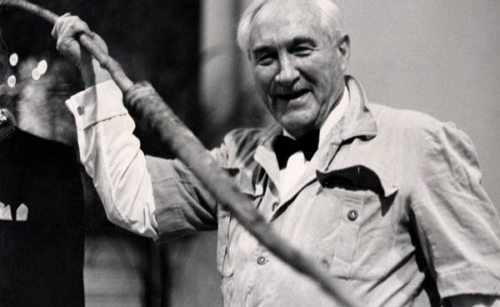
Louis Leakey showing off a spear at a fundraiser. Los Angeles, 1970.
“People frequently ask me why I devote so much time to seeking out facts about man’s past…the past shows clearly that we all have a common origin and that our differences in race, colour and creed are only superficial.”
-Louis Leakey
Louis Leakey (b. 1903, d. 1972) was a tireless promoter of the study of human origins, and exerted tremendous impact on the prevailing conception of early humans with his theoretical and paleontological work in the field.
In addition to the 20 books and over 150 articles he wrote in his lifetime, as well as the multiple fossil and stone tool discoveries that contributed so significantly to our understanding of the field, he was also largely responsible for convincing other scientists that Africa was the key location in which to search for evidence of human origins. Leakey’s early, controversial, yet unwavering position that Africa was the cradle of humanity has held up against modern scientific scrutiny, and is now universally accepted.
Louis was born on August 7, 1903 at Kabete Mission (near Nairobi), Kenya where his parents, Harry and Mary (Bazett) Leakey, were English missionaries to the Kikuyu tribe. Louis grew up speaking Kikuyu as fluently as English, and at age thirteen was initiated as a member of the Kikuyu tribe. He later (1937) wrote a definitive study of their culture.
Leakey began his university career at Cambridge University in 1922, but a rugby injury caused him to postpone his studies, and he left to help manage a paleontological expedition to Africa. He graduated with degrees in both anthropology and archaeology in 1926. After completing his degrees, Leakey began leading expeditions to Olduvai, a river gorge in Tanzania, where he found important fossils and Stone Age tools. In 1948 he reported finding a 20-million-year-old skull, which he named Proconsul africanus. Now considered to be too specialized to have been a direct ancestor of current ape and human populations, Proconsul is still considered scientifically valuable as a model for early human ancestors.
The first significant hominid fossil attributed to Leakey (a robust skull with huge teeth dated to 1.75 million years ago) was found by Louis’s collaborator and second wife, Mary Leakey. It was found in deposits that also contained stone tools, and Louis claimed it was a human ancestor and called it Zinjanthropus boisei (it is now considered to be a form of Australopithecus.)
Another important discovery was the 1964 reporting of Homo habilis (named by Louis, along with Phillip Tobias and John Napier), which Leakey believed was the first member of the actual human genus as well as the first true toolmaker. However, the interpretations of Leakey’s fossil finds are still controversial; their significance to the field of human origins is universally acknowledged.
Leakey also exerted influence in collateral areas, such as the emerging field of primatology. He was responsible for initiating Jane Goodall’s long-term field study of chimpanzees in the wild, and he helped obtain and coordinate funding for similar projects such as Dian Fossey’s work with mountain gorillas in Rwanda, and Birutė Galdikas work with orangutans in the Sarawak region of Indonesia.
Always a dynamic and energetic man, Leakey kept up a rigorous schedule of lecturing and fundraising. On route to a speaking engagement in London in 1972, Louis Leakey suffered a heart attack and died. Though he always had his detractors, Louis Leakey is considered to be a significant contributor to the understanding of our origins, and he radically changed the way we now view early humans. He strongly supported, in the face of great opposition, Darwin’s assertion that human evolution began in Africa; pushed back the known dates for the existence of various species; changed phylogenies to include the existence of parallel lines of evolution in the human family; and stimulated research in new fields like primatology, as well as generating interest and publicity for the study of human origins.