
Grantee Spotlight
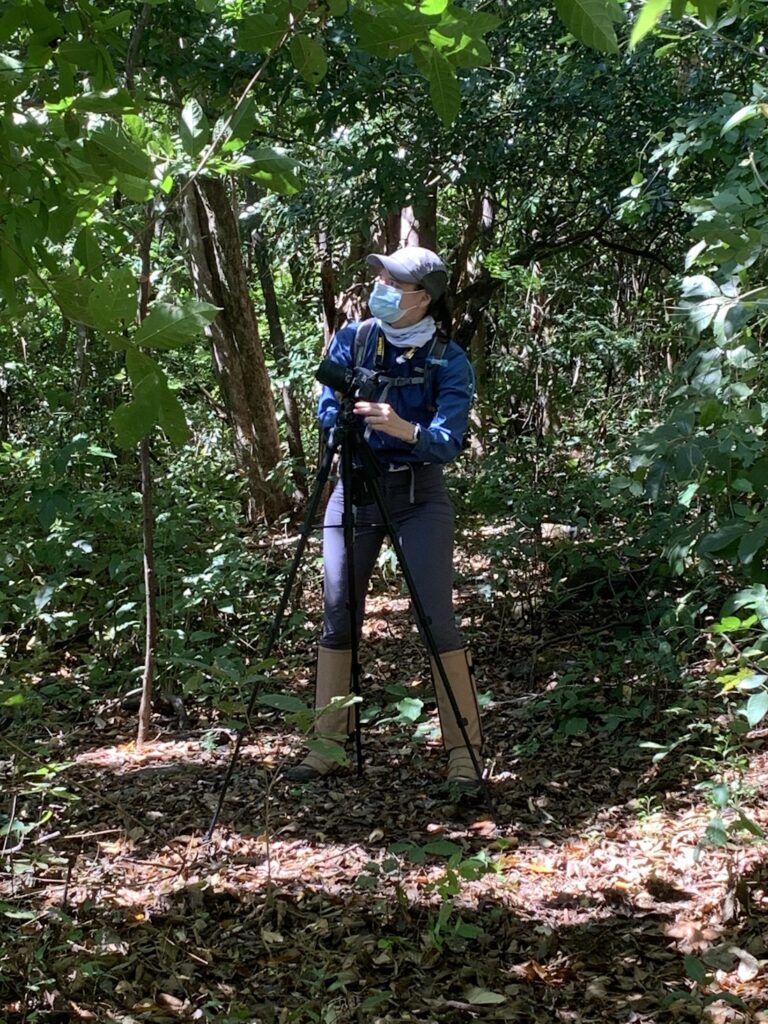
Myra Laird is a Leakey Foundation grantee and an assistant professor at the University of Pennsylvania. She studies how tiny scratches and pits called dental microwear form on the teeth of living primates with different tooth shapes and diets. By experimentally studying four primate species, she is figuring out how tooth form and the type of food combine to make microwear patterns. This work will help scientists better interpret what our ancestors ate and how their diets affected their evolution.
Myra’s love for fossils started in childhood, which led her to combine anthropology and geology in her studies to learn how feeding systems work through muscles, bones, and biomechanics. Her Leakey Foundation-supported research connects evolutionary biology with dental medicine to improve what we know about both ancient human evolution and modern oral health.
Questions and answers with Myra Laird
Tell us about your Leakey Foundation-supported project.
Your teeth pick up tiny scratches and pits—called “dental microwear”—from everyday contact with food, other teeth, and the environment. Scientists use these microscopic features to infer what extinct and living species ate, but the microwear on fossil teeth and most museum specimens reflects unknown foods over unknown periods of times. Measuring changes in these features in living primates has been challenging, and until now, experiments that track both the type of food and the timing of wear have only been performed in single species.
We will test a broad question: if primates with different teeth eat the same food, will dental microwear patterns differ? We will study four primate species that vary in diet and tooth size and shape, helping us understand how food and tooth form interact to create dental microwear. Studying dental microwear in living primates will inform interpretations of these features in our fossil ancestors and diet change in human evolution.
How did you become interested in paleoanthropology?
My fascination with fossils began as a child, and I have vivid memories of finding marine fossils throughout the Midwest. I even have a photo of me holding a mammoth mandible replica at the Mammoth Site near Hot Springs, South Dakota, perhaps previewing my future research at 7 years old! I was fortunate to have a broad training in anthropology and geology at the University of Iowa and to be able to participate in invertebrate and vertebrate fossil research through the Iowa Paleontology Repository. My interest in paleoanthropology evolved by combining my background in geology with human anatomy.
What big questions guide your research?
Our research will address three specific questions regarding dental microwear formation using an experimental approach: how dental microwear formation varies between food types, how fast different parts of the teeth are wearing, and how measures of occlusal size and shape relate to microwear formation. The answers to these questions will provide valuable information about the similarities and differences of dental microwear formation between species of primates, which may inform microwear differences in fossil hominins.
This project will address dental microwear formation in a controlled setting. While experimental work differs from real life, it will allow us to establish these fundamental functional relationships that would be challenging to test in the wild.
How did you feel when you learned you’d been selected for a Leakey Foundation grant? What will this funding help you do?
My lab studies the feeding system from a broad perspective, merging muscles, bones, biomechanics, and behaviors. I am excited and grateful for The Leakey Foundation’s support, as this project will broaden the work in my lab to include dental microwear in testing primate behavioral responses to diet.
Why is research like yours important?
Studying form-function relationships in the feeding system of non-human primates and fossil hominins has implications for our oral health. Microscopic dental wear accumulates into macroscopic wear over time, which can result in tooth decay (cavities), infection, and structural failure.
My research will test how the size and shape of teeth influences microscopic wear patterns, and in turn, these results can inform human oral health care by identifying dental sizes and shapes or parts of teeth that may be more likely to accumulate dental wear.
I’m a faculty member at the University of Pennsylvania School of Dental Medicine, where I teach anatomy to dental students. Our anatomy reflects our evolution, and health problems such as the frequency of third molar impaction (resulting in wisdom tooth removal) are a direct result of our evolutionary history. Understanding human evolution is basis for understanding humans today and has implications for health care.