
Grantee Spotlight
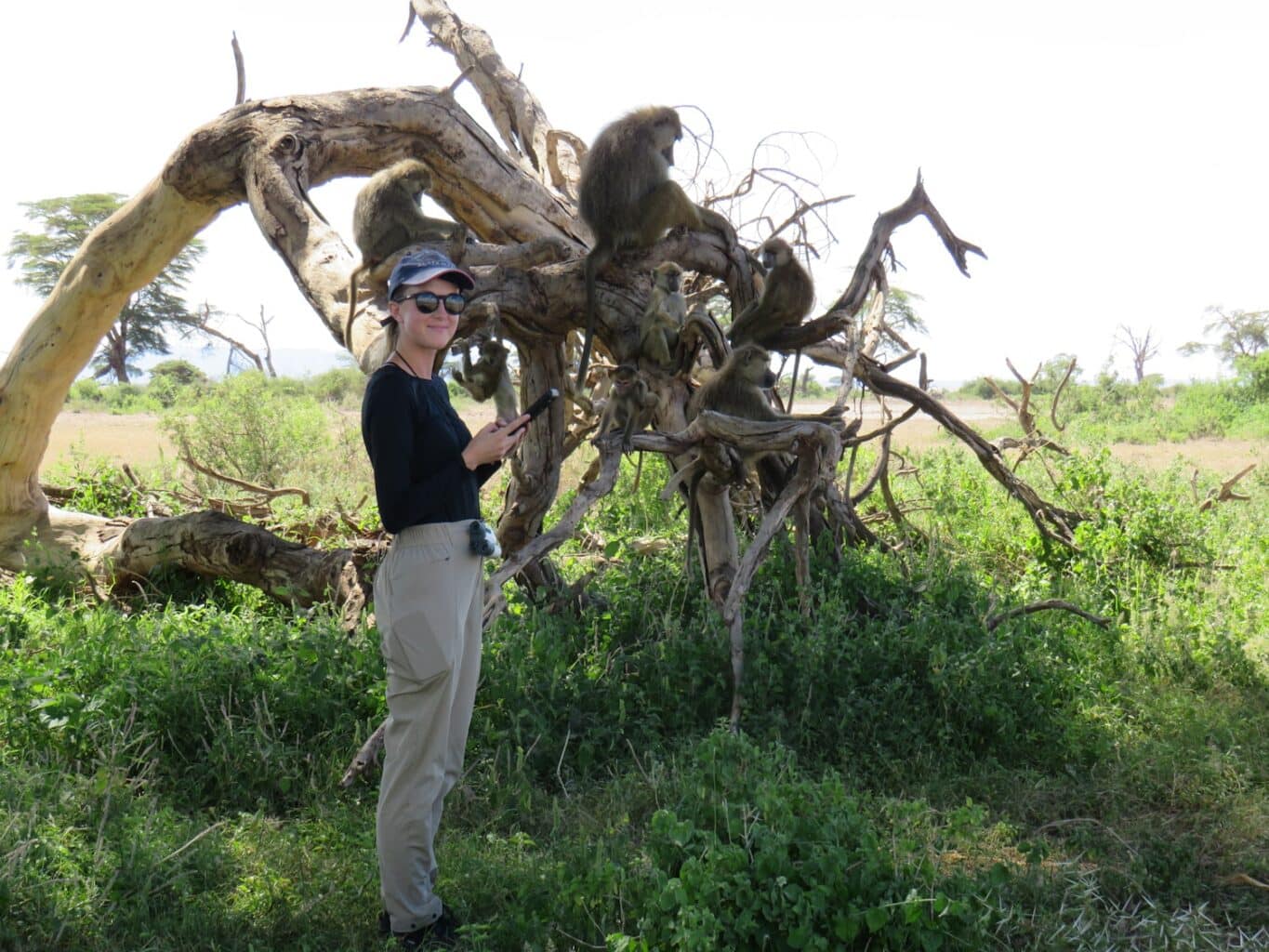
Maria Creighton is a PhD candidate at Duke University studying one of the most fundamental questions in human social evolution: does having strong social connections actually make you healthier, or do healthier people simply have more energy to be social?
To find out, she’s working with wild female baboons in Kenya’s Amboseli basin. The Amboseli Baboon Research Project, founded in 1971, is one of the longest-running primate studies in the world. The Leakey Foundation has supported the project and researchers there over the years. Maria’s 2025 grant continues that history, adding a new dimension to decades of data on baboon sociality, health, and survival.
Tell us about your Leakey Foundation-supported research project
Evidence from wild animal systems shows that more social individuals survive longer. In a one year study of baboons, I plan to investigate whether this effect is a result of sociality improving health (the “social causation” hypothesis) or healthier individuals socializing more (the “health selection” hypothesis).
What questions are you most interested in answering with your research and why?
I’m interested in asking about the causal relationship between social behavior and survival in baboons. Research on this topic has implications for our understanding of the adaptive advantages of sociality in primates and thus why species like humans have evolved to be social.

Did you always want to be a scientist?
I’ve always been interested in science, but I didn’t always want to become a scientist. I was a relatively apathetic and substandard student at points when I was young. I think that witnessing a number of publicized social and environmental events/injustices during my early life ultimately motivated me to go into research.
Seeing the far-reaching effects we as humans have on each other and the world around us led me to want to dedicate my life to understanding where we come from (through the study of primate evolution), and how we might limit these effects (through the study of behavior and conservation).
How did you feel when you learned you received your Leakey Foundation grant?
I was extremely thrilled and honored to receive a Leakey grant for my work. I’m excited that this grant will allow us to explore what has been one of the biggest knowledge gaps throughout my PhD.
What surprising discovery or challenging obstacle have you encountered in your work so far?
Correlation doesn’t equal causation! This is a famous mantra among scientists, but I don’t think people always fully appreciate its meaning. A lot of the work I do has been wrestling with how to better interrogate causal relationships in datasets that don’t easily allow for causal inferences.
Why should people care about human origins research?
Learning about how we came to be as humans has far-reaching implications for how we move forward as humans. From impacts in medicine, public health, and the social sciences, learning about our origins has already proven to have implications for us in the present day.
What’s your favorite mind-blowing science fact?
Chimpanzees have amazing short-term memories and can outperform humans in rapid numerical pattern recall.