
Grantee Spotlight

Juan Olvido Perea García, a Distinguished Professor at the Universidad de Las Palmas de Gran Canaria, is taking a closer look at human eyes. For decades, scientists have argued that the “whites” of human eyes are uniformly white, and that this whiteness evolved to make our gaze easier to follow. Perea García’s research, supported by a Leakey Foundation grant awarded in fall 2025, challenges both ideas. By measuring scleral pigmentation across diverse human populations, he is testing whether the “whites” of our eyes vary in response to the sun, as our skin does, and working to reconstruct what our ancestors’ eyes most likely looked like.
Tell us about your Leakey Foundation-supported research project
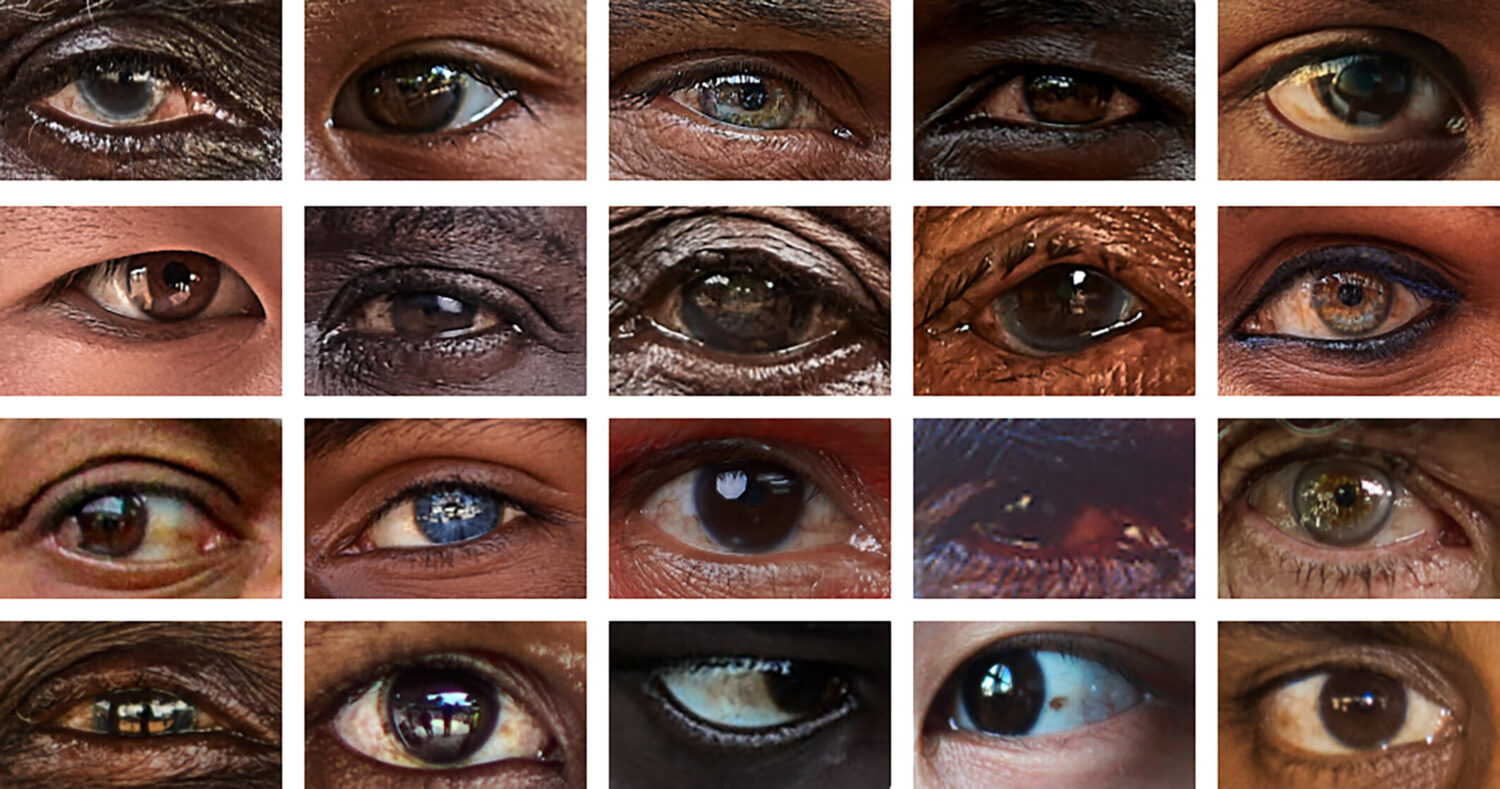
We have long believed that human eyes are special and unique among animals. The main idea was that human eyes were especially pale, so that the contrast between the iris and the sclera (the “whites” of the eyes) allowed us to follow gaze. But this conclusion was based on very limited data. The idea was based on a single study in which two researchers eyed a few photos of primates that appeared in some books. For some primate species, only one or two photos were observed, and many species were not included at all. This is shocking, right? That such a big conclusion was taken from just looking at some photos in some books – no measurements, just subjective impressions. The same researchers looked at a few hundred human photos and concluded that only humans had white sclerae, without pigment. Today, it is widely believed that all humans have whites of the eyes that are completely and smoothly white.
But this is simply not true. If you look closely at the eyes, especially of people with more melanin, or people who are exposed to the sun more than others, you’ll see a darker tint, sometimes with specks or irregular yellowish or brown shapes. Why did previous research conclude that human eyes lacked pigment in the sclera? This is a well-known bias in research – we focus too much on WEIRD (Westernized, Educated, Industrialized, Rich, Democratic) populations. We often ignore rural or tribal populations, and populations close to the equator or global south.
What does your project do differently?
My project wants to remedy this sampling bias. The idea is to use precise measurements to show that there is variation in scleral pigmentation across human populations. I also want to see if this variation is related to skin pigmentation. This is because I do not believe that gaze-following had a big impact on our eye appearance. Rather, we can follow gaze because our eyes were already easy to see. Humans do not need the kind of stark contrast that people with very little melanin may have between the iris and sclera to follow gaze.
Variation in scleral pigmentation is due to different needs to protect our eyes from the sun, just like variation in skin pigmentation. I also want to see if people whose ancestors come from closer to the equator have darker sclerae. Lastly, I would like to use these measurements, along with powerful statistical methods, to reconstruct the appearance of the sclera in our ancestors. This could support or contest the notion that scleral depigmentation evolved to facilitate gaze-following.
What questions are you most interested in answering with your research, and why?
I want to know whether skin and sclera pigmentation are similar in each person. This would suggest that both respond to the need to protect ourselves from the sun.
I also want to see if people whose ancestors lived closer to the equator tend to have more pigment in the sclera than those who descend from populations further from the equator. This would support the idea that scleral pigmentation is a way to protect our eyes from intense sunlight.
It would also be very thought-provoking to see if the measurements cluster people in distinct groups – this would suggest that different populations have different appearances because they respond to needs that are specific to said populations. In other words, if we lost pigment to make gaze-following easier, and gaze-following is important for all humanity, why do some populations have more pigment than others? Seeing that different populations have different eye appearances would strongly support the idea that eye appearance is not as closely related to gaze-following as we previously thought.
Another idea is to use these data to estimate the evolution of scleral pigmentation in our ancestors. If it responds to the need to follow gaze, this should be a clear and abrupt change that persists in modern human populations. Otherwise, we should expect that specific lineages vary in their pigmentation according to where they lived.
However, to me, the most beautiful part of this project will be to show the diversity of eye appearance in our species. Humanity’s eyes are diverse and beautiful. We all should know more about this.
What sparked your interest in eyes specifically and science in general?
For this specific project, the moment that got it all started was when I was living in Paris as a Spanish language teaching assistant. I was paid very little, but I had a lot of free time. I spent a lot of time in the métro. Coming from a smaller Spanish town, I was fascinated by the diversity of the people riding the métro. After doing this for a while, I noticed that people reliably looked back when I was staring at them. I started wondering how they could sense that they were being looked at.
Some time later, I realized I, too, could feel when others were staring at me. I spent a long time trying to figure out what exactly gave me this feeling. Eventually, I could see that, right before I felt looked at, there was a quick “flash” of dark and light – when people’s eyeballs moved, their iris and sclera changed positions quickly and made them into some kind of organic blinkers that announced that the person shifted their gaze.
In general, though, when it comes to my interest in evolution, zoology, and anthropology, I have my mother to thank. Before taking her daily “siesta,” she’d leave documentaries about people or animals on TV. While she slept, I watched these documentaries in utter fascination. She was also my introduction to the world of dinosaurs. During the dino-fever ignited by Jurassic Park in the early 1990s, I’d ask her to buy me magazines because of the illustrations. I still couldn’t read, so she made sure to read everything to me. Thanks, mom.

How did you feel when you learned you received your Leakey Foundation grant? What impact will this support have on your life and career?
I remember perfectly. I stared at my wife in disbelief. Before I had time to express joy, I was overcome with anxiety. Suddenly, my summertime was crammed with work! And very important work!
I feel very lucky, grateful, and excited that the reviewers and The Leakey Foundation’s Scientific Executive Committee trust me for this important task.
Even though “multidisciplinary” has become a buzzword, it is extremely hard to do research as a multidisciplinary researcher. You’re an outsider in all fields. Receiving a Leakey Foundation grant can be a seal of quality for other institutions to vouch for the quality and relevance of my work. My hope is that having received this prestigious grant will help my projects be taken seriously.
Why should people care about human origins research?
Once you understand the fundamentals of our origins (which is all we currently know), a lot of harmful ideas can’t take hold in our minds. This is especially relevant today, when powerful world leaders turn to hateful rhetoric to convince us that “we” are fundamentally different from other groups. In the past, it happened with race. Today, it’s also happening with “nationalities” or “cultures.” When you understand how new nations and “ethnicities” are, and how far back our lineage goes, the idea that we are different is laughable.
How can research related to human evolution help us understand or solve a significant challenge we face today?
To put it very simply, it is not wise to act on something we don’t understand. As shocking as this may be, we still do not understand ourselves enough.
I think this is what people outside of research have to understand. We have inundated the media with the idea that we know everything – that we know what this part of the brain does, that we have mapped the entire world, or have cataloged all species of spider, or primate. How could we not know our own species? But the truth is, our collective knowledge is composed of very few individual contributions talking to themselves. We are constantly taking absence of evidence as evidence of absence, and being very happy to conclude that we know all there is to know.
We need to be more humble, convey how ignorant we are, and how urgent it is to dedicate more resources to the never-ending enterprise of learning. Knowing humanity is the only way we have to ensure we do not become complicit in being inhumane.

Is there anything we haven’t asked that you’d like our readers to know about you or your work?
My specific topic of research – what human eyes look like, and why they look like that – has transformed radically in the last 7 years. I would encourage any curious readers to look into it. This change showcases how research looks at itself critically, and how intuitions become evidence, and evidence accumulates into theories. A good review that takes a snapshot of this transformation is Perea‐García, J. O., Teuben, A., & Caspar, K. R. (2025). Look past the cooperative eye hypothesis: reconsidering the evolution of human eye appearance. Biological Reviews.
What are your favorite mind-blowing facts related to human evolution?
• Light penetrates our eyeballs through its tissues (apart from the pupil), so eye color may actually influence how we see – perhaps we don’t all see the same colors!
• Even though we’ve made a lot of reconstructions of hominins in our lineage, the eye color was completely made up by the artists. We do not know what our ancestors’ eyes looked like.
• There is, on average, more genetic variation within human groups than between them.