
Archaeology
34,000-year-old stone tools from Georgia reveal humanity’s earliest known use of indigo.

By Evan Hadingham
A casual visitor to the National Museum in Georgia’s capital, Tbilisi, wouldn’t have given it a second look. It was an ordinary-looking rock— a large, smoothly rounded pebble exhibited in one of the display cases. However, for Laura Longo, one of the museum’s curators and now an archaeologist at Ca’ Foscari University of Venice, it was the focus of intense interest.
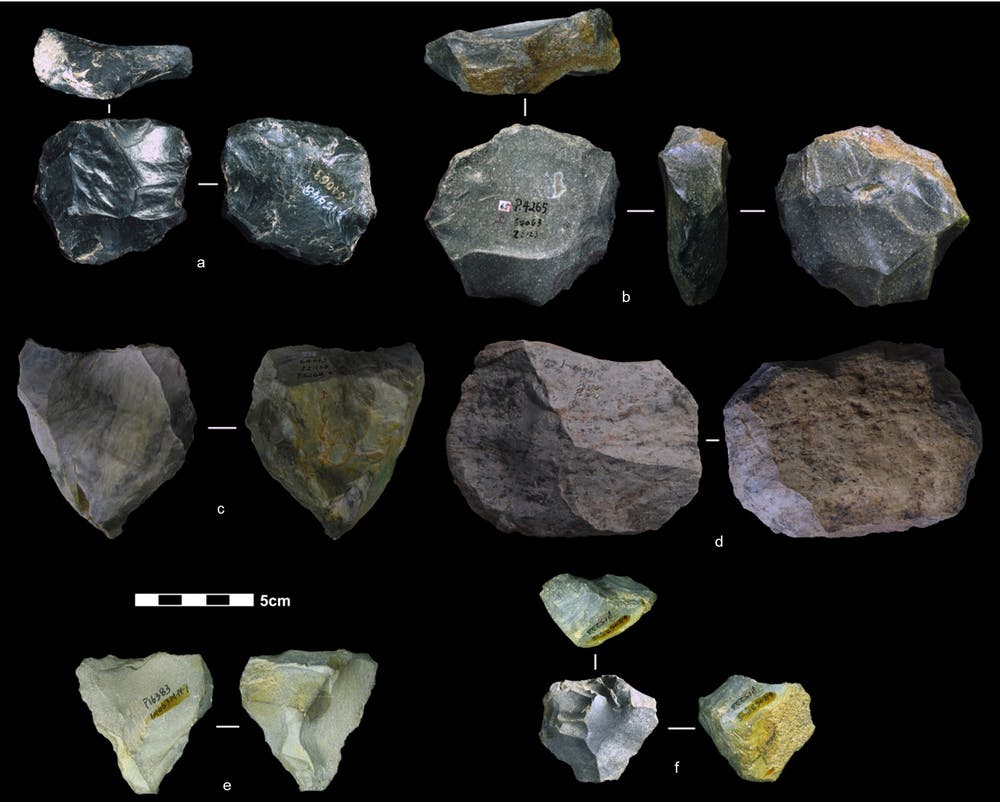
For over a decade, Longo had been investigating similar large pebbles that keep turning up in excavations of European Ice Age sites, ranging from Italy to Siberia. Most archaeologists have ignored them because of their traditional focus on sharp-edged, flaked stone tools, which were used for slicing or scraping meat and hides, or for arming spears or arrow shafts. Conveniently sized for gripping in the hand, the smooth-sided pebbles would have been well-suited for pounding, bashing, and grinding. Was that how they were used? And, if so, what were they used on?
A closer look
To aid their detective work, Longo and her colleagues needed to reveal normally invisible clues from the pebbles’ surfaces. They were looking for traces of wear and fragments of whatever they had ground or pounded. Her team developed a cross-disciplinary approach, combining advanced microscopic imaging techniques. The techniques included X-ray synchrotron imaging and spectroscopic analysis of organic material trapped in the crevices of the stones. Their research has shown that the pebbles were essential tools for producing a whole world of perishable, plant-based items that have vanished from the archaeological record. A variety of evidence suggests that the plants processed by the pebbles were used in making items such as nets, baskets, footwear, string and rope, textiles, and flour.
But when Longo’s team used the same techniques to examine the pebble in the display case along with five others just like it in the Georgian National Museum’s collections, they discovered something even more remarkable. These ordinary-looking rocks proved to be the key to an intricate chemical extraction process and a striking example of prehistoric technical ingenuity. While tests continue and questions remain to be resolved by further research, the pebbles’ evidence may even link the clothing of our Ice Age ancestors to the ubiquitous blue jeans of today’s world.

A child’s love of rocks
“It’s easy to say I’ve been doing this since I was a kid,” Longo explains, “but it’s true! I started collecting little pebbles during strolls around my kindergarten. My Mom saved some of those fragments, and as I got older, I realized they were actually filled with fossils.” Longo grew up in hilly countryside near Verona, where the reddish-pink limestone rocks are rich in fossilized ammonites. Her childhood fascination ultimately led her to the University of Bologna. Her graduate research there involved detecting use-wear traces on flaked stone tools from the early stages of Europe’s Gravettian culture, dating to around 30,000 years ago.
Eventually, she became intrigued by the neglected puzzle of the pebbles, which archaeologists refer to as ground stone tools, or GSTs. In 2010, she co-authored a landmark paper demonstrating that GSTs from Gravettian sites in Italy, Russia, and the Czech Republic had been regularly used to process vegetable foods, including the grinding of flour from wild plants. The study argued that, as a high-energy resource, flour would have been a crucial item in the food economy of Ice Age hunter-gatherers, some 20,000 years before the invention of agriculture.

Launching the investigation
Meanwhile, Longo had begun visiting Georgia’s National Museum, drawn by the richness of its collections from prehistoric sites in the foothills of the Caucasus. [As a gateway between Europe and Southwest Asia, the corridor between the Caucasus and the Black Sea played a key role in the peopling of Eurasia for over two million years, first by Homo erectus, and later by Neanderthals and modern humans. ]
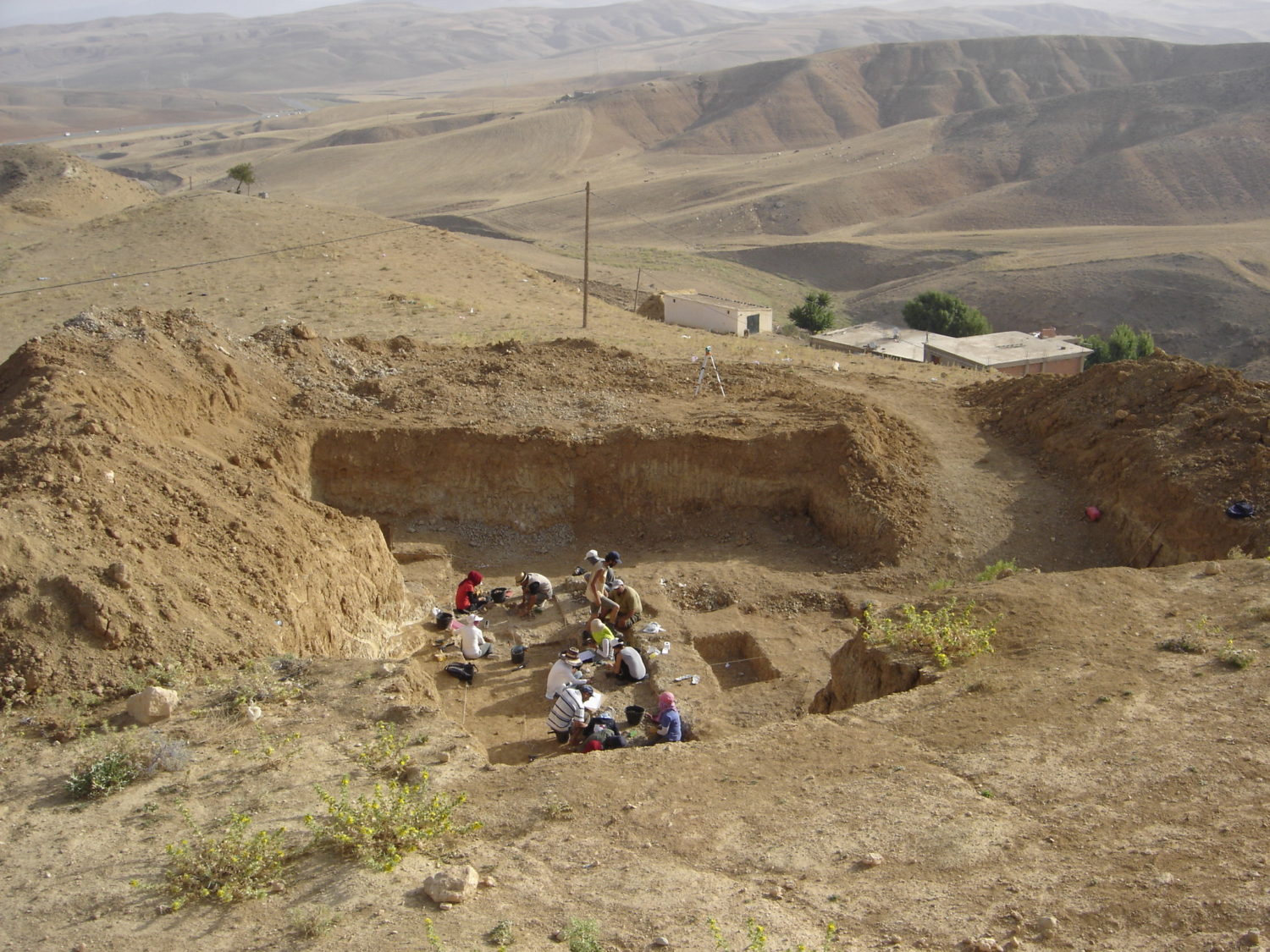
Among the region’s many important sites is Dzudzuana Cave, where the pebbles in the National Museum were found during excavations between 1996 and 2008 led by a joint team of Georgian, American, and Israeli archaeologists. The digs showed that hunter-gatherers had occupied the cave in four distinct phases spanning some 20,000 years. The pebbles came from the oldest levels, dated from 34-32,000 years ago, a period of relatively mild climate in which wild grapes, hazel, oak, and beech trees had grown nearby.
Supported by The Leakey Foundation, a team led by Longo and Elena Badetti of Ca’ Foscari launched an investigation of the six Dzudzuana pebbles at the National Museum. From the start, they struck Longo as unlike any GST’s she had previously studied. “They were not straightforward grinding stones. Our analysis showed that they had been used in different stages of activity: not only for pounding, but also as boiling stones, heated to raise water temperature.”

Indigo blue molecules
Her team’s microscopic imaging revealed tiny starch grains trapped in the rocky crevices alongside something unusual: a bluish, fibrous residue. With the help of infrared and Raman spectroscopy carried out by M. Veronese at the University of Padua, the team identified a single blue-colored molecule in the residue known as Indigotin.
Today, indigo—a pigment derived from Indigotin—is mostly associated with blue jeans, although nearly all denim is now colored with synthetic dyes. At least fifteen species of wild plants can be used to extract indigo, including one native to the Caucasus. Collectively, they are often referred to as “Dyers’ Woad.” Their leaves don’t contain a blue pigment, instead, they have ‘precursors.’ These are glycoside compounds that are transformed through oxidation into the blue Indigotin molecule at the end of an intricate extraction process.
Over three summers, Longo’s team used materials available in the Paleolithic to replicate two different possible extraction techniques (see box below). Both methods would have clearly required sophisticated knowledge of plant ecology and technical mastery of a complex chemical reaction.
Woad warriors, healers, and dyers

Why was all this ingenuity focused on extracting indigo? Popular illustrations of ancient Celtic men in Britain often depict them as fearsome warriors, their bodies painted in intricate blue woad patterns. This association of woad with the Britons stems from a passage in Julius Caesar’s Gallic Wars in the mid-first century BC, in which he writes that all the Britons dyed themselves with a bluish substance. Caesar’s statement has encouraged Celtic reenactment enthusiasts in Britain to experiment with woad and deck out their bodies in blue.
Body painting during the European Ice Age is certainly a possibility, since crayon-like pieces of colorful minerals (notably red and yellow ochre and black manganese dioxide) have been found at many sites, sometimes showing signs of scraping and rubbing consistent with marking surfaces or skin. The Dzudzuana pebbles are a hint that other shades could have been available for body painting, too.
Woad also plays a role in traditional healing. Its roots contain flavonoids, antioxidants that are claimed to reduce the risks of diabetes and heart disease. In addition, the Indigotin precursors in woad leaves are said to have preservative, antiseptic, and repellent properties. A co-author of Longo’s study, Karen Hardy of the University of Glasgow, is convinced that these medicinal uses need to be factored in to interpreting the pebbles.
But the popularity of blue jeans is a reminder that until the era of synthetic dyes, woad’s biggest use was for coloring fabrics and textiles. Another discovery at Dzudzuana Cave offers a tantalizing hint that dyeing thread or cloth may have been the ultimate purpose of the indigo extracted at the site with the help of the enigmatic pebbles.
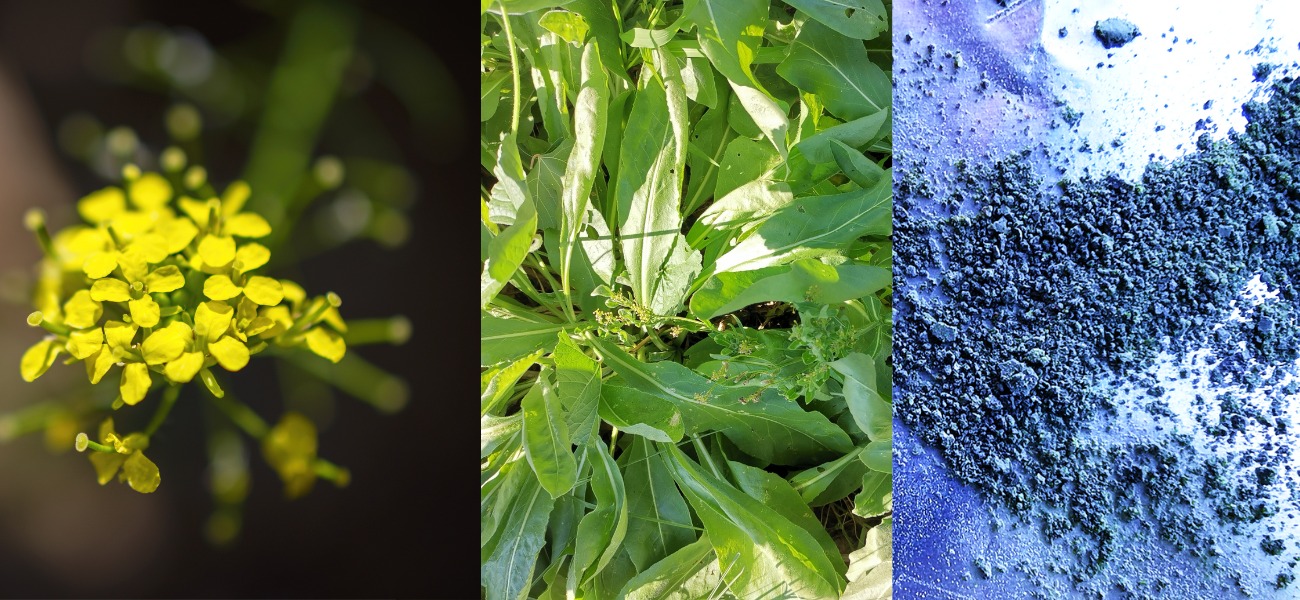
Dyer’s woad (Isatis tinctoria L.) flowers, leaves, and powder.
The flax fiber clue
In 2007 and 2008, Leakey Foundation grantee and Harvard archaeologist Ofer Bar-Yosef and Eliso Kvavadze of the National Museum returned to Dzudzuana Cave to collect soil samples from the four main occupation levels. When they examined the samples under the microscope, they saw stringy fragments of wild flax fibers in all four levels — a total of more than 1,000 in all.
From the 34,000 year-old layer in which the pebbles were found, they counted nearly 500 fibers. Many of them had been modified: some appeared to have been spun and deliberately cut. Mixed in with the fibers were tiny remnants of beetles, mites, moths, and hair from mountain goats. The presence of a fungus (Chaetomium) that typically lives on and destroys clothing strengthened their theory that the cave had been used for fabricating colorful textiles. Nearly sixty of the flax fibers were dyed in shades ranging from turquoise and pink to black and gray, probably extracted from local plants—perhaps including woad. Although there is evidence that Neanderthals made string from bark fibers, the flax fragments from Dzudzuana represent the world’s earliest known examples of dyed fibers.
A new picture of plant use
The innovative interdisciplinary work of Laura Longo and her colleagues conjures up a different image of our ancestors than the one familiar from cartoons—the meat-dependent caveman roughly clad in skins. Instead, her research redefines them as masters of an array of vegetable resources and complex chemical processes, and perhaps wearing colorful clothes.
“Surviving the Ice Age required enormous ingenuity, and our experiments prove it,” Longo says. “Archaeologists are used to seeing this in durable artifacts, but it is much less obvious when it comes to processing plants, since those traces are so perishable. The ability of Homo sapiens to transform a wide range of raw materials is a hallmark of their success.”
Dig Deeper
Extracting the blues
Several traditional methods of preparing indigo from woad are documented in historical sources, some dating back to ancient Greece. Longo’s team experimented with two of them to see if the procedures left traces similar to those on the surfaces of the Dzudzuana pebbles.
Method 1
In the first method, they used the pebbles to thoroughly pound and grind the leaves into a green pulp, which they then shaped into fist-sized “woad balls.” The team left them to ferment over several weeks, during which the woad gradually transformed into Indigotin. Finally, they pounded the dried balls with the pebbles to produce a powdery pigment. This experiment left behind wear marks and fiber fragments on the experimental pebbles identical to those they observed on the Dzudzuana ones.
Method 2
The second technique was more elaborate, and involved steeping the woad leaves in hot water. The team dug a pit and lined it with deer skins to contain the water, then added rocks that had been pre-heated in a fire. Next, they added ash from beech trees to raise the alkaline content of the solution. They also oxygenated the brew by stirring it with a stick.
Over the next 24 hours, the insoluble Indigotin gradually settled out of the mixture and formed a powder in the bottom of the container. Surface damage on the Dzudzuana pebbles suggests that some of them were used to heat up water, as required by this second process. The technique is demanding; it only works if the temperature and pH of the reaction are strictly controlled.

Read the research 🔓
Laura Longo, Mauro Veronese, Clarissa Cagnato, Giusi Sorrentino, Ana Tetruashvili, Anna Belfer-Cohen, Nino Jakeli, Tengiz Meshveliani, Moreno Meneghetti, Alfonso Zoleo, Antonio Marcomini, Gilberto Artioli, Elena Badetti, Karen Hardy. Direct evidence for processing Isatis tinctoria L., a non-nutritional plant, 32–34,000 years ago. PLOS One (2025). https://doi.org/10.1371/journal.pone.0321262

Evan Hadingham is the author of Discovering Us: 50 Great Discoveries in Human Origins. He is a writer, documentary producer, and science communicator who worked for decades as Senior Science Editor for the PBS science series NOVA.