
Grantee Spotlight

Jacqueline Garnett is a 2024 Leakey Foundation grantee and a PhD candidate in anthropology at Washington University in St. Louis. She studies how dietary differences among primates influence their evolvability or their capacity to respond to evolutionary pressures like environmental change.
Jacqueline Garnett’s Leakey Foundation–funded research involves building 3D models of primate teeth using photogrammetry to measure dental traits across species. By comparing these traits with published dietary data, she is testing whether some primates may be more evolutionarily flexible than others based on what they eat. Jacqueline Garnett is especially interested in how these patterns help explain hominin adaptation and resilience, as well as what they suggest about the challenges primates face today.
Questions and answers with Jacqueline Garnett
What questions are you most interested in answering with your research?
My research essentially asks what the impact of previous evolution is on future evolutionary potential. I’m fascinated by the interaction between the external pressures that organisms face and the internal constraints that may either prevent or facilitate evolution in the face of those pressures. It’s as if you’ve gone down this path and meet a fork in the road, and because of everything you have (or haven’t) picked up along the way, one path is going to be more difficult to go down than the other.
It’s incredibly important to understand how organisms can and cannot respond to environmental challenges, especially in light of the unprecedented rate of environmental change in recent history. I’m excited to use my toolkit as an evolutionary biologist to answer relevant questions today and help us interpret key moments in the past that brought us to where we are now.
Tell us about your Leakey Foundation-funded project
The evolution of humans and other primates has been, in large part, shaped by diversification in diet. One underappreciated role that diet may have played in the evolution of humans and nonhuman primates is through shaping evolvability, which is the ability of a species to respond to an evolutionary pressure, like environmental change.
My research asks whether there is a relationship between evolvability and different diets in primates (for example, if fruit-eating species are consistently more evolvable than leaf-eating species) and whether patterns of evolvability are similar within primates who have more similar diets or who are more closely related to each other.
To answer this question, I need to know two things: what does each species eat, and how evolvable are they? To obtain information about a species’ diet, I will record information that has already been collected and published by other researchers. To calculate evolvability, I need to travel to two museum collections in the United States to look at the specimens housed there.
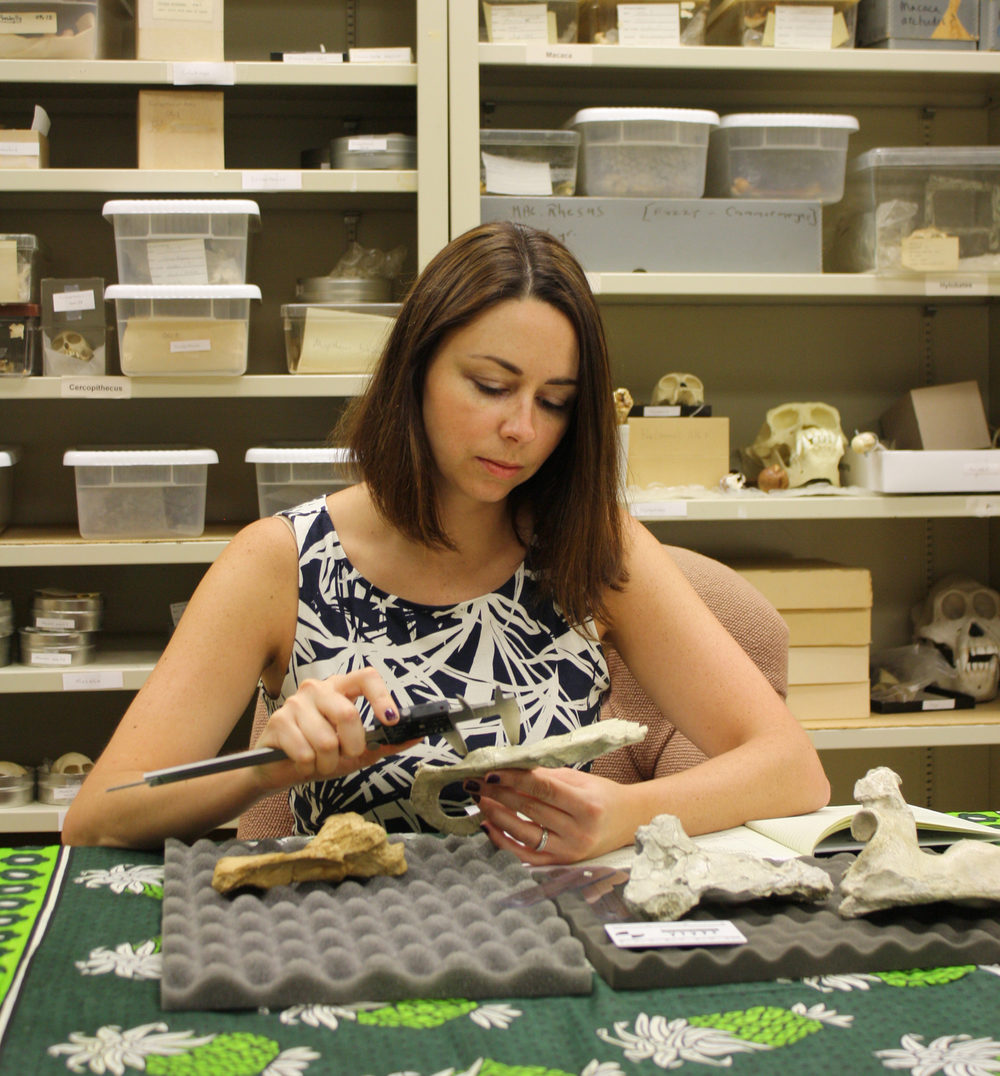
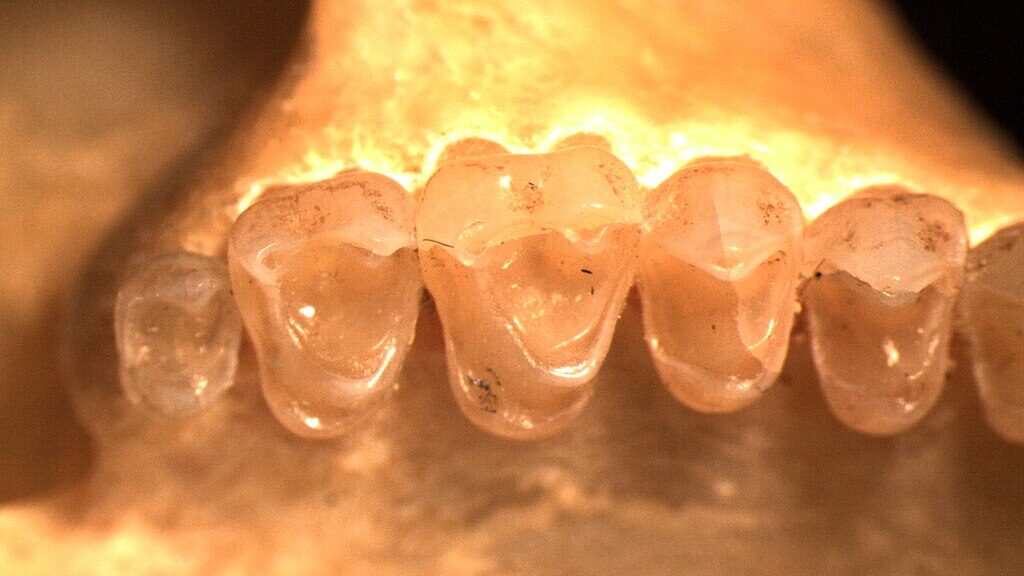
At these museums, I will take a series of photographs to create 3D models of primate teeth using a process called photogrammetry. From these 3D models, I collect information about different dental traits, like the position of the tips of teeth and how tall they are. From these traits, I can calculate evolvability and compare these values across species and in relation to what we know about their diet.
If a pattern exists between diet and evolvability, this implies that previous evolution towards a particular diet may leave some species more vulnerable to environmental change than others.This information gives us important insights into how dietary evolution impacted the ability of hominins to respond to changing environments. It also sheds light on how similar forces may be impacting living primates today.
How did you become interested in science?
Science was always my favourite subject in school. I remember learning about evolution for the first time, and ever since then, I haven’t looked back. Understanding evolution has helped me make sense of the world and continues to spark curiosity about life on Earth and the history of our planet. But my love of science is also still changing.
In my professional career, I’ve gained a greater appreciation not just for science, but for all of the people behind the work that we do. This community of people using science as a tool to tackle global problems is what inspires me today. This has caused me to reflect on the role of science in society a lot more intentionally. Science touches our lives in ways that we often don’t think about. So, alongside my research, I’ve also become increasingly interested in science communication and public outreach. I love being able to spark joy in others and find the ways in which science impacts people’s everyday lives.
I know that my love of science will continue to grow and change. Whatever the future holds, I hope that I can continue to do fulfilling work that is also exciting for others.
How did you feel when you learned about your Leakey Foundation grant?
I was over the moon when I learned that The Leakey Foundation would support my research.
As scientists, we are often so passionate about the research questions we want to answer. The less exciting but equally important truth about seeking to answer those questions is that there are many practical considerations we need to keep in mind. For example, I need a very large dataset to conduct reliable statistical analyses to answer my research questions, and collecting that data requires a lot of time and money.
Simply put, without funding from organizations like The Leakey Foundation, I would need to reduce the scope of my research and would not be able to answer the question I originally sought. As a young researcher, this funding is incredibly validating because it means that someone else reviewed my ideas and said, yes, the question you want to answer is worth our time and money because it will make an important contribution to our understanding of the world. This support gives me more confidence in my ideas. It is an important jumping-off point for the rest of my career because it allows me to make a significant contribution to my field. I am so grateful for this support, and I cannot wait to get started!
Why is human evolution research important?
Understanding human evolution helps us appreciate our place within the tree of life. Not so long ago, a great diversity of hominin species existed alongside each other, but now they are no longer here. It’s a pretty odd position to be the only surviving member of such a recently diverse group.
Research into human evolution is important because it reminds us that there are countless paths our ancestors could have taken and that (along with some randomness and good fortune) the consequences of each step along the way ultimately led us to where we are today.
Human origins teaches us that our evolutionary history is complicated, finicky, and fragile, but also that it’s full of uniqueness, innovation, and creativity. It helps us to answer some of the deepest questions about our own history, and from my point of view, it allows us to see our unique place in nature in the same way that we do the unique place of all other species. By applying that same curiosity to other species as I do towards ourselves, I feel a greater sense of connection and responsibility to the environment and the natural world.