
Grantee Spotlight

What you eat is changing your gut microbiome. So is where you live, what’s in your water, and the antibiotics that have made their way into your environment. But how quickly does that happen, and how much does it matter?
Shehani Fernando, a PhD candidate at the University of Notre Dame, received a Leakey Foundation research grant in 2025 to investigate exactly that. She studies toque macaques (Macaca sinica) living across a spectrum of human influence in Sri Lanka, from undisturbed forest to city streets. Closely related to humans and often living alongside us, these primates may be showing us in real time how quickly organisms can adapt to environmental change and how human activity impacts health at the microbial level, in wildlife and in ourselves.
Questions and answers with Shehani Fernando
Tell us about your Leakey Foundation-supported research project
My research looks at how rapid human-driven environmental change affects health and adaptation by focusing on the gut microbiome – the community of microbes living inside our digestive system. These microbes play a crucial role in digestion, immunity, and overall health, and they can change much faster in response to environmental changes.
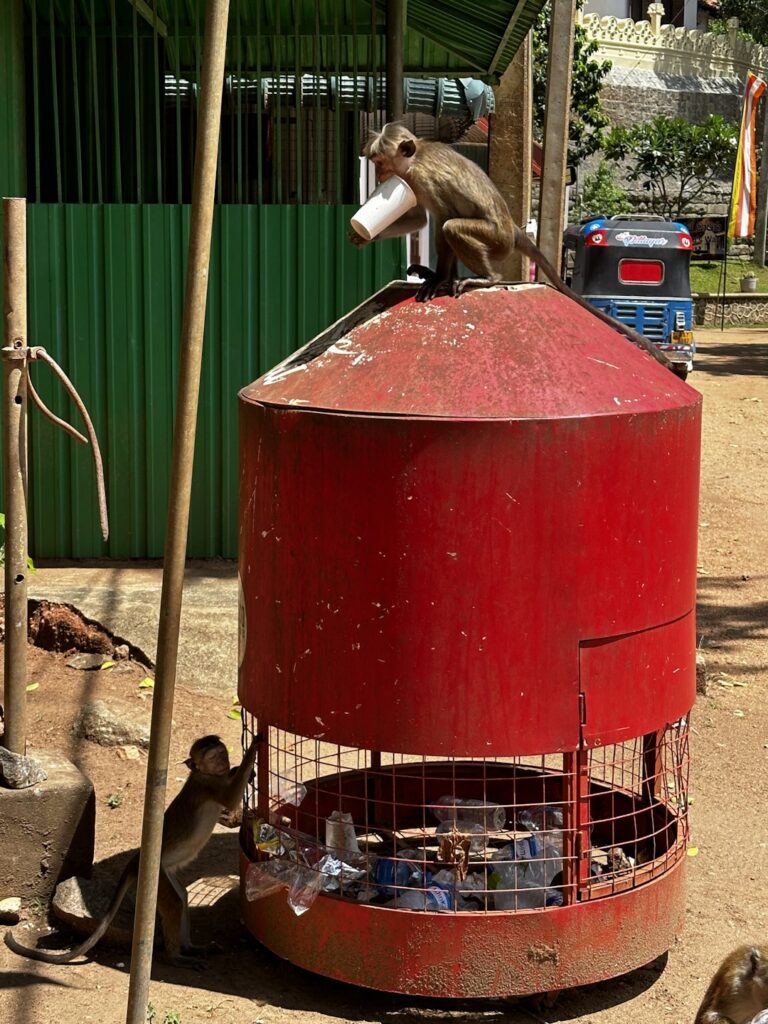
I study toque macaques in Sri Lanka that live in different habitats: dense urban areas, suburban regions, and undisturbed forests. Because these macaques are closely related to humans and often live alongside us, they offer a powerful way to understand how human activity shapes gut microbiome.
In cities and towns, macaques are exposed to human waste, processed foods, pollutants, and antibiotics released through medicine, agriculture, and the environment. These exposures can change the gut microbiome and encourage the spread of antibiotic-resistant and potentially harmful bacteria. By comparing macaques across urban, suburban, and wild habitats, my research explores how these pressures shape gut microbes. Not just which microbes are present, but what they are capable of doing.
Ultimately, this work helps us understand how quickly organisms can adapt to new and stressful environments, and how human activity may be driving changes in health at the microbial level in both humans and wildlife.

How did you become interested in studying macaques and the microbiome?
I’ve always been interested in how humans and animals adapt to changing environments, but my path into this field really solidified during my undergraduate research. While working with macaques, I was struck by how closely they interact with humans and how differently they interact with humans across urban, suburban, and wild habitats.
Seeing these same species adjust their behavior, social relationships, and resource use depending on where they lived made it clear to me that environment shapes biology in powerful ways. As I continued my research, I became especially interested in the gut microbiome and its ability to change rapidly within a single lifetime. Realising that these microbial communities might help primates cope with new environments while also carrying risks like antibiotic resistance brought together my interests in evolution, conservation, and health.

What questions are you most interested in answering with your research and why?
I am most interested in understanding how exposure to human activity, especially antibiotics and environmental contamination, changes gut microbiomes within a single lifetime. Specifically, I ask whether macaques living in cities carry more antibiotic-resistant and potentially harmful bacteria than those living in forests, and how these changes affect the overall function and stability of their gut microbiomes.
These questions matter because antibiotic resistance is a growing global health threat. Studying it in wild primates allows us to see how resistance emerges and spreads outside of hospitals and laboratories, at the boundaries where humans, animals, and the environment interact. By understanding how human pressures shape gut microbiomes in primates, we can gain insight into early human evolution, wildlife conservation, and the unintended health consequences of urbanization.
This research highlights the gut microbiome as a fast and flexible system that may help organisms cope with environmental change, but also one that can be disrupted in ways that carry health risks.

How did you feel when you learned you received your Leakey Foundation grant?
When I learned that I had received support from The Leakey Foundation, I felt a mix of gratitude, relief, and motivation. This support has an immediate impact on my life. It allows me to carry out my sample analyses that would otherwise be financially out of reach, and it gives me the freedom to focus fully on research rather than on piecing together short-term funding. Just as importantly, it provides a sense of stability and confidence that is invaluable at an early career stage.
What’s your favorite mind-blowing fact related to human origins, evolution, or your field?
Bones are living fossils- Remodeled every 7-10 years, recording activity and stress. By the time you are 30, you have likely cycled through three entirely different skeletons, and by age 60, perhaps five.