
Grantee Spotlight

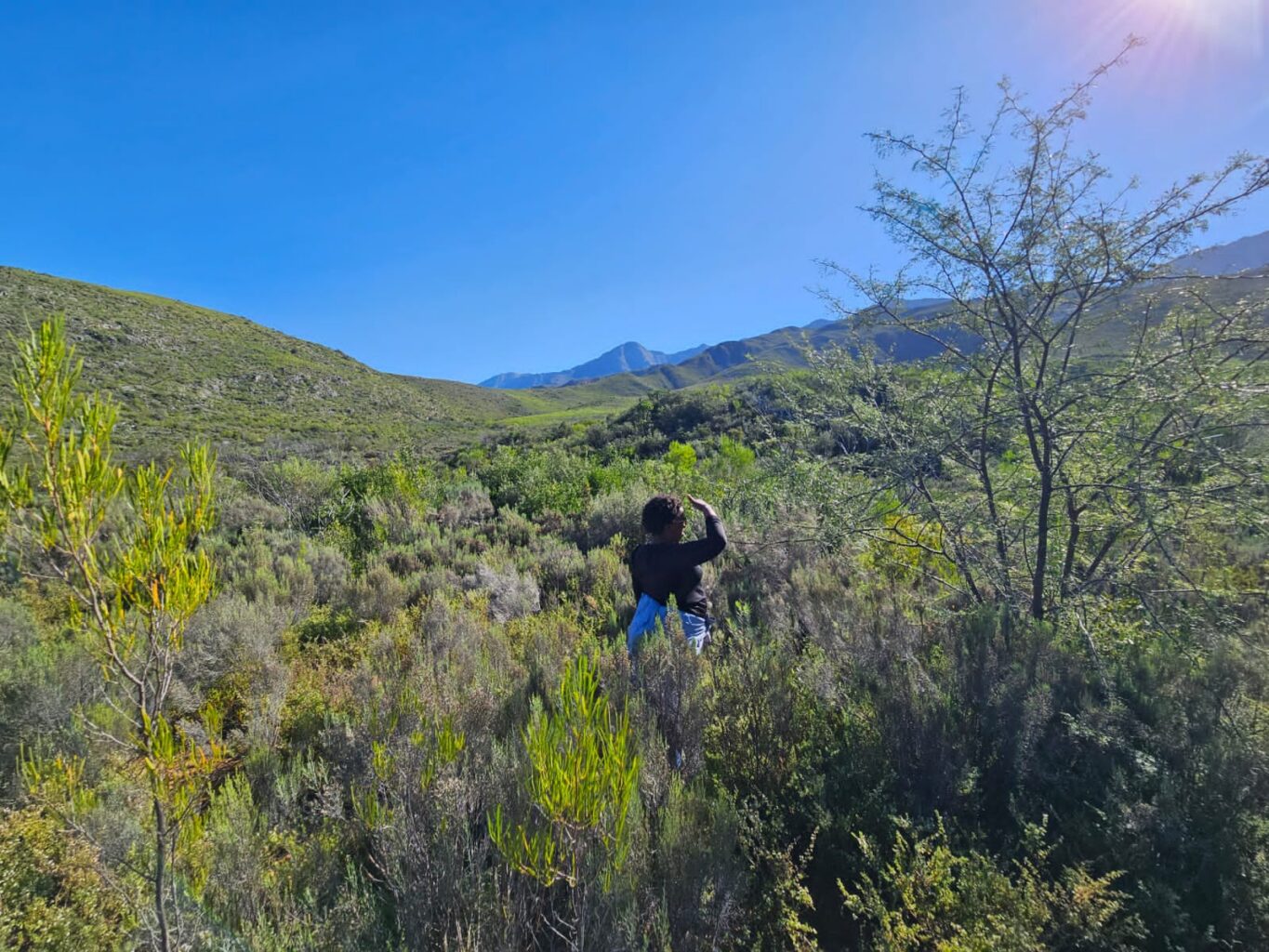
Asithandile Ntsondwa is a doctoral student New York University whose research focuses on human-environment interactions and the role of fire in shaping ancient landscapes. She received a Leakey Foundation Baldwin Fellowship in 2025.
Originally from the Eastern Cape Province of South Africa, Asithandile has a background in botany and paleoecology, having completed both her master’s and bachelor’s degrees at Nelson Mandela University.
At NYU, Asithandile is conducting research that combines anthracology, paleoecology, and archaeology at Boomplaas Cave in South Africa. This cave is an important Stone Age site for understanding the archaeology and occupation history of Southern Africa because it is one of the rare inland sites occupied by humans across thousands of years and through multiple climate cycles. Asithandile’s work there challenges long-standing narratives that early hunter-gatherers were passive recipients of environmental change.
In addition to her research, she is a skilled science communicator who has appeared on The Leakey Foundation’s Origin Stories podcast twice (see her episodes below). Upon completion of her PhD, she plans to return to South Africa to develop academic programs in archaeobotany and paleoecology, fields of study with limited local expertise.
Questions and Answers with Asithandile Ntsondwa
Tell us about your research. What questions are you trying to answer?
My PhD project aims to understand the relationship between human occupation intensities at Boomplaas Cave and fire histories at the cave and surrounding landscapes. It is to understand the role hunter-gatherers may have had in shaping the surrounding vegetation using fire. I will be focused on generating high-resolution fire records and charcoal identification from Boomplaas cave and from hyrax middens from the Swartberg Mountains, all in South Africa. The questions I’m interested in include:
- What impact, if any did hunter-gatherers living at Boomplaas have on the fire management of the landscape? i.e., Did the occupants suppress landscape fires or increase them?
- How can charcoal be used to identify human occupation intensities?
- What is the overall relationship between hunter-gatherer mobility, landscape fires, and fuelwood selection?
How did you become interested in pursuing archaeology?
I’ve always been drawn to science, especially its ecological aspects, and knew early on that it was something I wanted to pursue. I pivoted to archaeology in my master’s year after working at the Boomplaas Cave to gain fieldwork experience.
That experience sparked a deeper interest in understanding the human story, how people have shaped and been shaped by their environments over time, and led me to want to explore that further through research.
How did you feel when you learned about your Baldwin Fellowship?
I felt and still feel truly honored and grateful to have been awarded the Mosher Baldwin Fellowship. I am still overwhelmed with gratitude and excitement. It feels both validating and energizing to know that a foundation with such a strong legacy and impact in human origins research has awarded me such an honour.
This support not only enables me to carry out my fieldwork and data collection while working in my host and home country but it also gives me the confidence to pursue bigger questions and contribute meaningfully to our understanding of past human-environmental interactions. On a personal level, this fellowship will really assist me on the financial aspect of covering my basic living expenses, especially in a foreign country. Since, I just finished my first-year of coursework at New York University, I would not say I have had any suprising discoveries but I have been excited to transition to a different style of doing a PhD, than what I would have done in South Africa.
Why is human origins research important or relevant today?
Human origins research helps us understand who we are, where we come from, how far we have come to shape the world around us, and to make predictions of what we can do and be in the future. It reveals a deep history of human adaptation, migration, and resilience, which are all valuable to know in our current global challenges such as climate change, environmental degradation, and displacement of communities.
By studying and understanding how past human populations interacted with each other and their environment, building the world we know today, we gain a long-term perspective that can inform how we progress as a species. Charles Darwin was not right about everything, pertaining to his explanation of evolution, which is a sign that there is still so much we do not know as humans and so much to still uncover.