
Grantee Spotlight

Tobias Deschner is a 2024 Leakey Foundation grantee, a primatologist with the Max Planck Institute for Evolutionary Anthropology, and co-director of the Ozouga Chimpanzee Project in Gabon. He studies the behavior, tool use, and cultural practices of wild chimpanzees, focusing on how behaviors and traditions are learned and passed from one individual to another.
Over the last twenty years, Tobias Deschner has studied wild chimpanzees at sites across Africa, including Taï in Côte d’Ivoire, Budongo and Ngogo in Uganda, and Gombe and Issa in Tanzania. He has also studied bonobos at Lui Kotale in the Democratic Republic of the Congo.
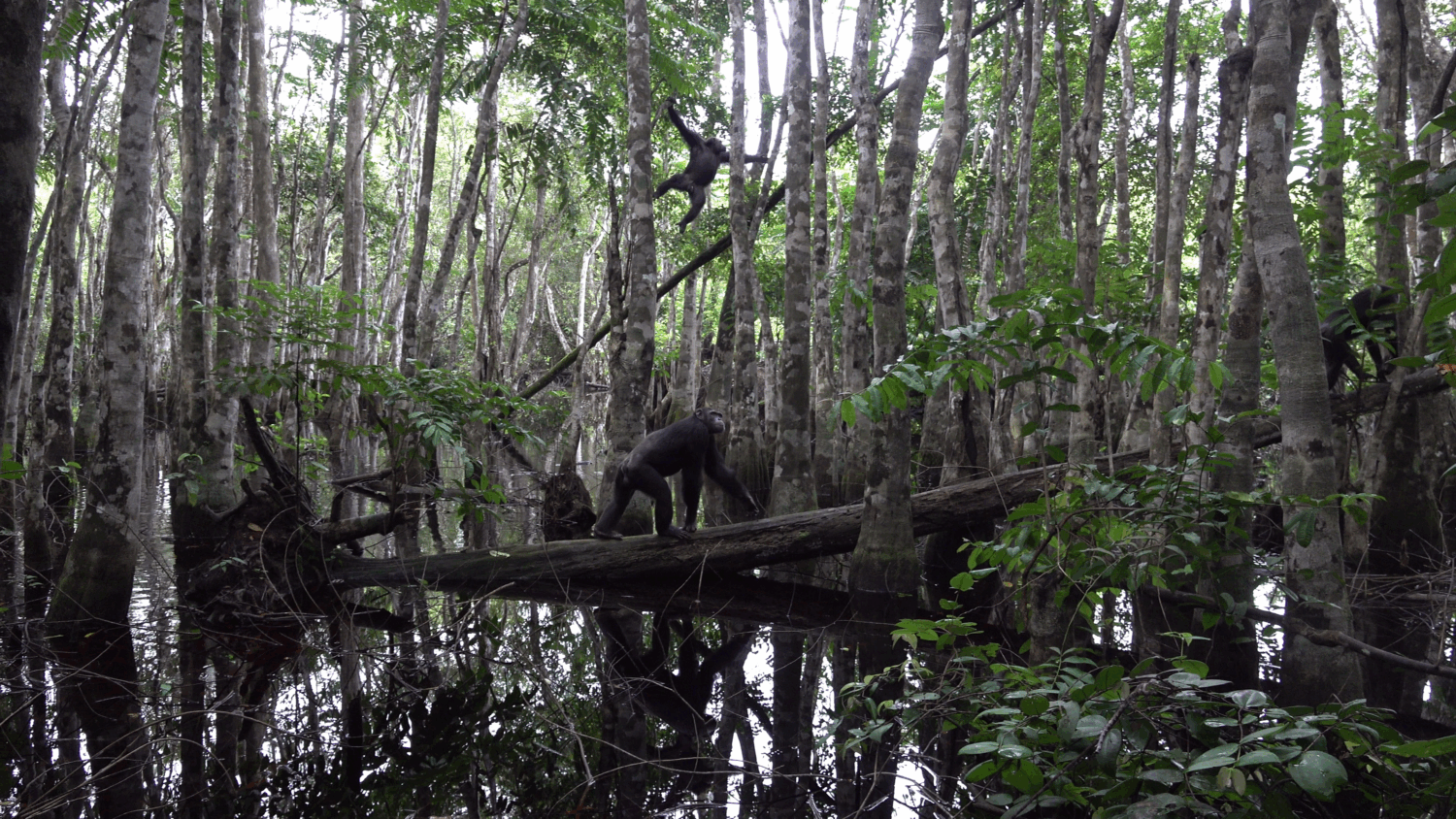
His Leakey Foundation-funded project explores whether nut cracking, a complex behavior seen in West African chimpanzees, can emerge in a different chimpanzee population when tools and nuts are made available. By placing stone and wooden hammers under nut-bearing trees and observing with camera traps, Tobias and his team aim to find out whether this behavior can arise spontaneously or if it requires social learning.
Through his work in Gabon, Tobias hopes to deepen our understanding of animal behavior and contribute to the conservation of great apes and their habitats.
Questions and answers with Tobias Deschner
How did you become interested in chimpanzee behavior?
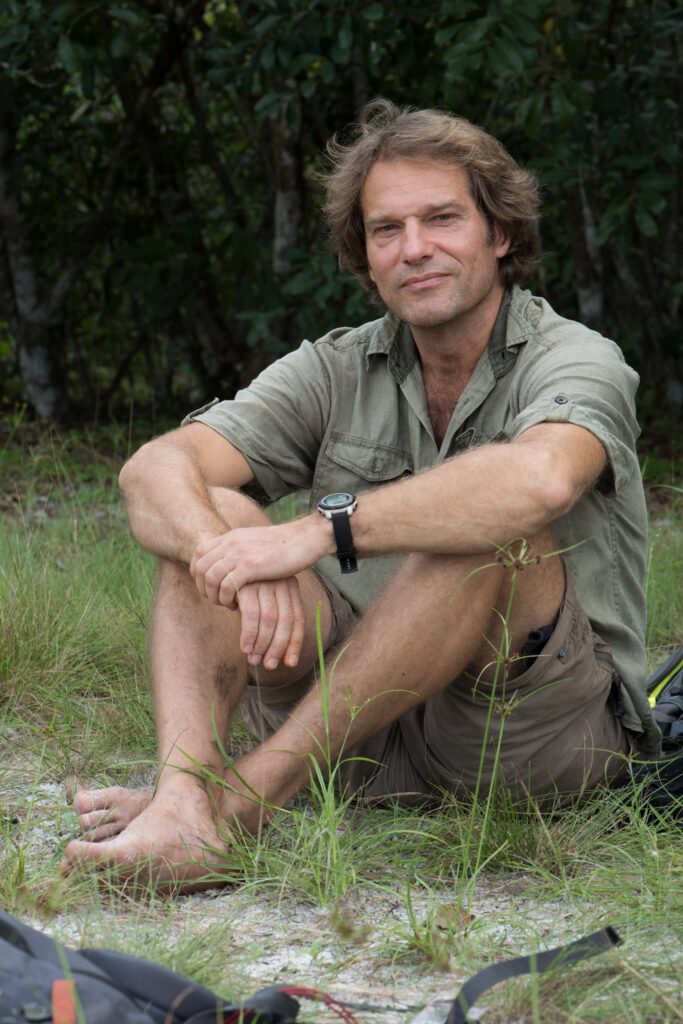
Since I was a small child, I have been fascinated by animals. That’s why I studied biology and as soon as I could, I specialized in behavioral biology. I took advantage of a unique opportunity to do my master’s thesis on Colobus monkeys in Taï National Park in Côte d’Ivoire. After I worked on chimpanzees for my doctoral thesis, these animals stuck with me, and I continued to research them, first in the Taï National Park and then in the Loango National Park in Gabon.
What questions are you most interested in answering with your research?
What fascinates me most is the tool use and culture of animals. For a long time, it was assumed that tool use was a behavior unique to humans. It wasn’t until Jane Goodall observed chimpanzees fishing for termites with probes that we slowly came to the realization that animals are also capable of making and using tools. But we still don’t understand everything. How is tool use learned? Why do species differ in the extent to which they use tools? How does human environmental degradation affect the transmission and spread of tool use across populations? These and other questions will concern us for years to come, and chimpanzees, with their uniquely diverse tool use, are an ideal species for research on this topic.
Tell us about your Leakey-funded research project
For decades, we’ve known that chimpanzees crack nuts with stone and wooden hammers in a small area in West Africa. However, the nuts they crack can be found in a much wider area in tropical Africa, where wild chimpanzees are present as well. Why aren’t chimpanzees cracking nuts there? Is nut cracking an easily invented behavior that can be picked up by chimpanzees once nuts, hammers, and anvils are available at the same place? Or is nut-cracking a highly complex cultural behavior that once invented, was refined over generations and transmitted through social learning from one generation to the next?
We will test this with nut cracking experiments in a population of chimpanzees in the Loango National Park in Gabon. We will provide hammers under nut-bearing trees next to remote camera traps and explore whether chimpanzees will pick up the nut cracking technique they use in West Africa.
How did you feel when you learned you had received a Leakey Foundation grant?
Finding out that I had received a research grant from The Leakey Foundation filled me with great joy. Of course, it is always a great relief to receive financial support for a research project. But it is just as important to get confirmation that other researchers think the project is interesting and worthy of funding.

Why is research like yours so important?
Research on chimpanzees and other great apes allows us to see how similar these animals are to us in their intelligence and emotions. We don’t have to travel through space to discover more intelligent life, we have it right next to us. Nevertheless, we are continuing to destroy these animals’ habitats in the wild, and if we are not careful, we will leave our children with a world without these unique species. We should do everything in our power to prevent this from happening.
Why is studying human evolution relevant to our lives today?
Studying human evolution allows us to understand where we come from and why we humans are the way we are in our strengths and weaknesses. It allows us to understand our species in the context of its environment and gives us impetus to solve pressing environmental, political and social problems.

What’s your favorite mind-blowing science fact?
Chimpanzees use crushed insects to treat the wounds of others.