Grantee Spotlight
Humans and other primates grow up slowly, have relatively few offspring, and live longer lives than most mammals. Slow life history patterns are one of the things that make humans and other primates unique, but they also make primate life history difficult to study. Long lives and long intervals between generations mean that researchers need decades of data to understand primate life-history strategies.
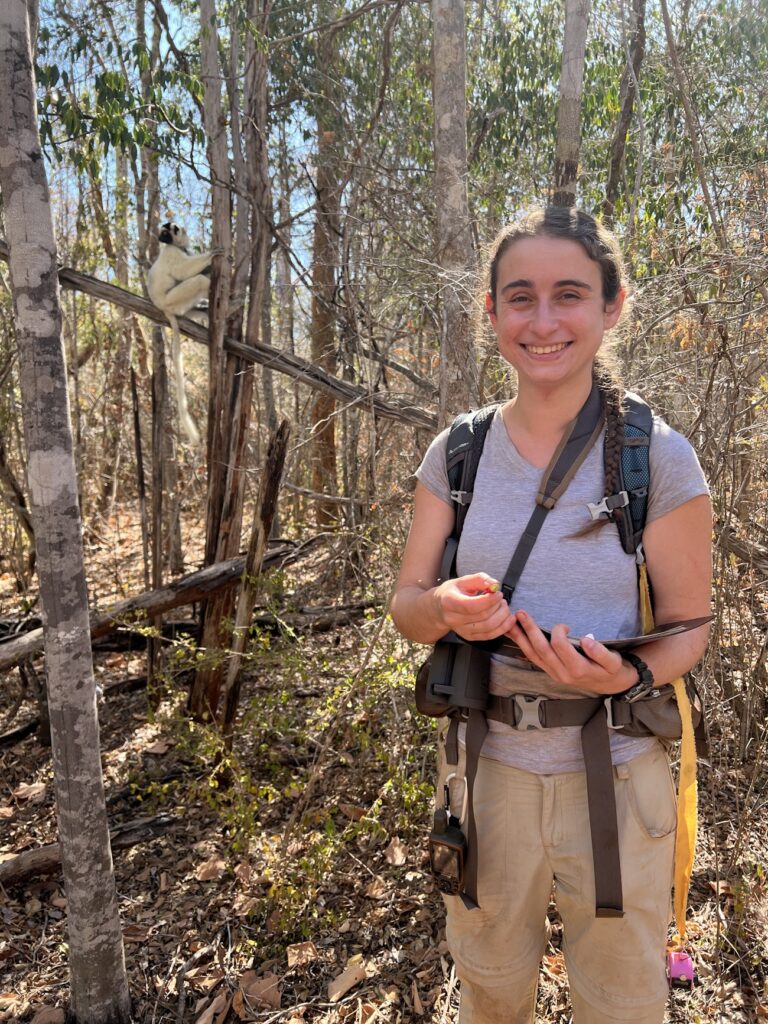
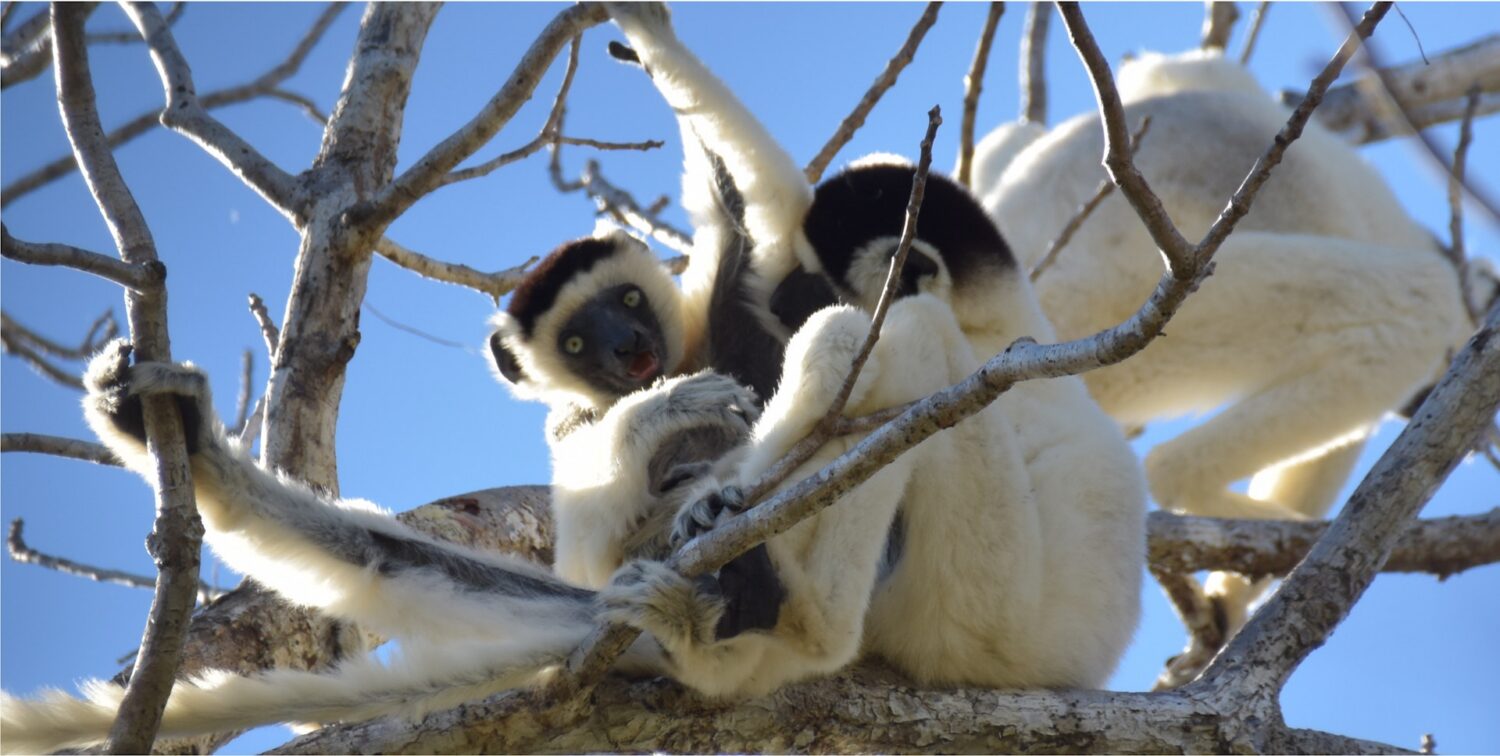
Gabrielle Bueno, a Leakey Foundation grantee and PhD candidate at the University of Texas at Austin, is studying a critically endangered lemur species, Verreaux’s sifaka (Propithecus verreauxi), across three stages of its lifespan. Her project combines 59 years of data from two populations in Madagascar to learn how these lemurs invest time and energy resources during early development, adolescence, and adulthood.
Questions and Answers with Gabrielle Bueno
Tell us about your Leakey Foundation-supported research project
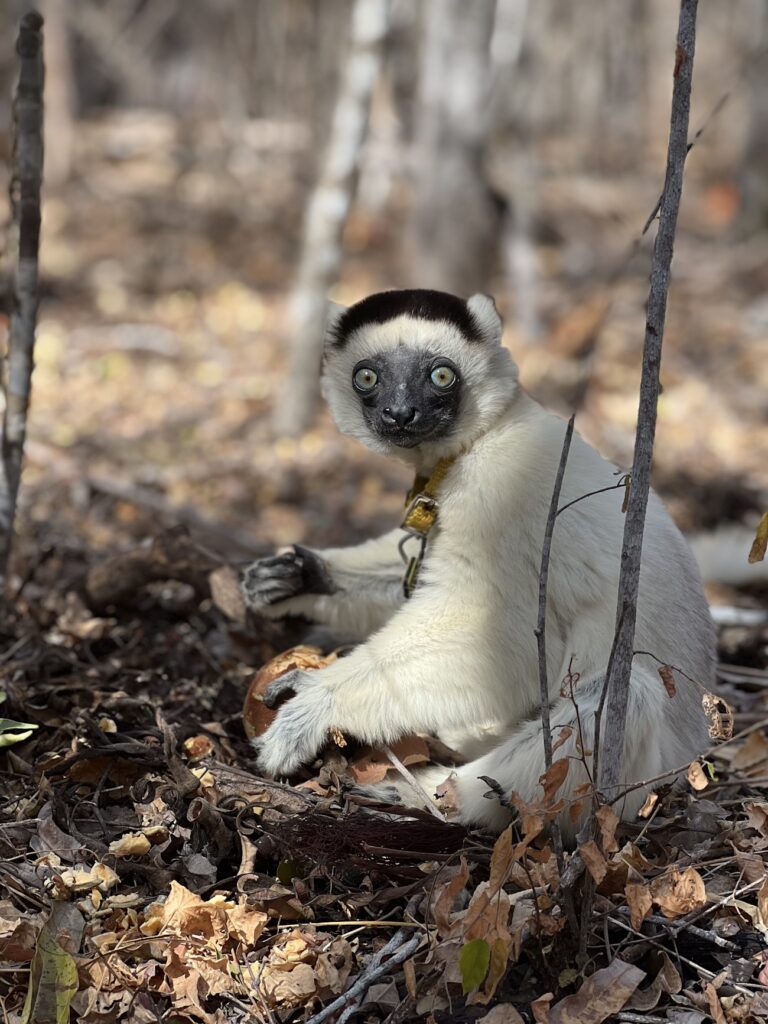
I study development and reproduction in wild Verreaux’s sifaka, a fascinating but critically endangered primate found only in western Madagascar. My Leakey Foundation-supported research examines two main topics. First, and more generally, I study how sifaka developmental and reproductive timelines respond to environmental variation. Second, I study whether female sifaka change their diets during pregnancy to include micronutrient and plant secondary metabolite supplements, similar to supplements human mothers use.
What are some of the questions you hope to answer with your work?
What are the limits to flexibility in life history strategies, i.e., the limits to variation in life “timelines”? What are the causes and consequences of this flexibility? How will sifaka and other primates respond to increasing natural disasters, and how will that impact their demographics and survival? What are direct ways we can improve their survival chances, e.g., what are the most important food trees we can include in targeted reforestation efforts?
How did you get into studying wild lemurs?
I have always loved animals, but when I got the opportunity to work with captive capuchins at age 16 ,I fell in love with nonhuman primates and knew I’d do anything to work with them. Their intelligence, behavioral complexity, general sass, and just the clear feeling that a person was looking back at me when we locked eyes put me on the path of no return.
When I was an undergrad, I studied primate cognition and worked with captive macaques, and while I was thrilled to learn more about primate cognition, I still felt like something was missing. But when I studied abroad in Madagascar in my senior year, I fell in love again. This time with fieldwork.
I adored running through the forest after lemurs, living in a tent, and even collecting samples (if you know you know!). The year after graduating I returned to Madagascar to conduct fieldwork with ring-tailed lemurs in Ivohiboro Rainforest, and then worked as a lab manager in a different cognitive evolution lab for two years before starting graduate school at UT Austin. I feel very lucky to now be back in the field studying wild primates, and to get to know individual lemurs (from a safe distance) while studying the captivating topic of evolution.
How did you feel when you learned about your Leakey Foundation grant?
I was absolutely overjoyed and beyond grateful to get a Leakey Foundation grant! I cannot overstate how excited I was. I immediately called my parents and a few fellow primatologists who understood the importance of this grant. They were thrilled as well. Because of the current funding situation in the US, I had been making backup plans about which samples and tests I could cut to save money. I tried to calculate the absolute minimum I needed to complete my dissertation, even though all 500+ of my samples had already been collected and were all necessary to answer my questions. I am so grateful that, thanks to Leakey, I will be able to fully analyze every sample I collected. This means no blood, sweat, tears, or previous grants will be wasted in my pursuit of a better understanding of sifaka.
What have you found most challenging about studying wild lemurs?
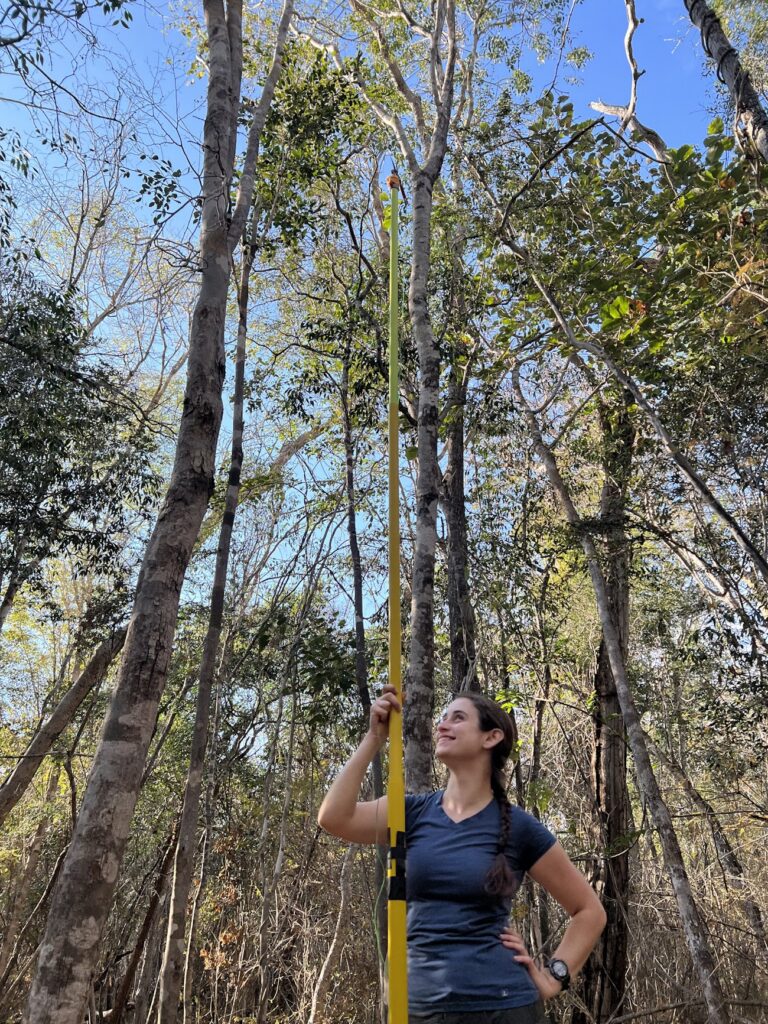
One thing I discovered early on is just how challenging and time-consuming it can be to accurately collect feeding and nutrition data from wild primates. In previous studies I’d worked on, we just recorded time spent feeding and the food item–should be enough, right? But if you want to really understand a primate’s diet, it requires your full attention and leaves few opportunities to collect much additional data or do anything else. My team and I spent 12 months using a clicker counter to record every single bite each lemur took (difficult when they’re high up in a tree in the middle of the foliage and eat fast), becoming semi-experts in botany, and devising tools to collect leaves and fruit from 20+ feet off the ground without harming the trees. The latter was much more of an arm workout than any of us expected.
Why is human evolution research important right now?
Understanding how humans evolved is vital to understanding who we are today and who we will become. The entire world, humans included, is facing an enormous challenge in the form of the climate crisis. However, our past is also one key to unlocking the solution. Humans are one of, if not the most, flexible, resilient, and adaptable creatures on earth. Humans have survived and thrived in nearly every environment, overcoming incredible obstacles to get to where we are today. By studying human evolution and our amazing behavioral flexibility, we can hopefully shed light on how to help our closest relatives (primates) and other animals and ecosystems similarly adapt, build resilience, and thrive, as well as safely navigate this crisis ourselves.
What about lemurs might surprise people?
Something surprising to a lot of people is that lemurs are the most endangered group of mammals on Earth. Over 94% of the 100+ species are vulnerable to extinction, and the people who work and live in Madagascar are watching them disappear before our eyes. Lemurs live only on Madagascar, and beyond having value in and of themselves, represent a fascinating branch of non-catarrhine primate evolution that can help us better understand ourselves, how we evolved, and the world around us.
Lemurs need to be protected, and while the road to helping them is complex, it involves both protecting their habitats and supporting the Malagasy people. One way everyone can help is by supporting organizations that save lemurs from extinction by helping both lemurs and people, and a list of these conservation organizations can be found here: https://www.lemurconservationnetwork.org/how-to-help/members/. Other ways to help from anywhere are included here: https://www.lemurconservationnetwork.org/how-to-help/.
Do you have a favorite science fun fact?
Wild capuchins rub toxic millipedes on themselves that act as mosquito repellent! The crushed millipedes secrete benzoquinone, which reduces mosquito landings and feedings on the monkeys. Some lemur species (namely some Eulemur) also rub toxic benzoquinone-secreting millipedes on themselves, and while the effect that behavior has on mosquitoes and other parasites hasn’t been studied directly, it has a side effect of making the lemurs look and act rather intoxicated.