

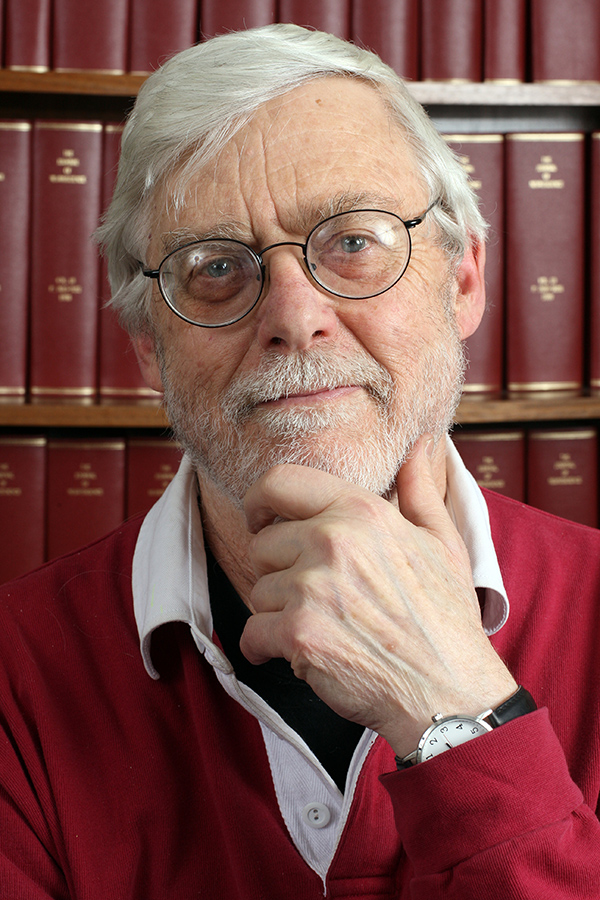
Dr. Jon Kaas (1937- )
Brief biography
Oral history interview recorded June 19, 2026
Interviewer: Bernard A. Wood
Jon Kaas was an 18-year-old working in a creamery in Spooner, in very rural Wisconsin, when a chance meeting in a bar took him to Northland College on Lake Superior. There—after switching from engineering to psychology—the College president wrote personal letters to graduate schools on his behalf. After graduate school at Duke and a post-doc at the University of Wisconsin-Madison, in 1987, Kaas moved to a faculty position at Vanderbilt University, where he is currently a Distinguished Professor of Psychology and a Gertrude Conaway Vanderbilt Professor.
Kaas is one of a relatively small number of laboratory scientists who focus on primates, and he is the doyen of an even smaller number of neuroscientists who do so. Researchers who study primates in the wild document how individuals and social groups search for dependable sources of food and water, how they interact with their peers and avoid predators. All these activities depend on sensory—especially visual—inputs. Kaas’s specialization is understanding how the brain processes the multi-sensory information that enables primates to survive and thrive in a such a wide range of habitats.
In his interview, Kaas—a long-time Member of the National Academy of Sciences—gives us some clues about what lies behind his own extraordinary productivity and the long-term success of his laboratory at Vanderbilt. He also recounts several occasions in which his career circumstances forced him to switch research topics, explaining how he converted a series of potential setbacks into opportunities to develop himself and the ingenuity of his research program.
Oral History Transcript
The transcript below is free to read and download.
Further reading
The History of Neuroscience in Autobiography, Volume 9: Jon Kaas
Selected publications
Top cited
Pons, T. P., Garraghty, P. E., Ommaya, A. K., Kaas, J. H., Taub, E., & Mishkin, M. (1991). Massive cortical reorganization after sensory deafferentation in adult macaques. Science, 252(5014), 1857-1860.
Merzenich, M. M., Kaas, J. H., Wall, J., Nelson, R. J., Sur, M., & Felleman, D. (1983). Topographic reorganization of somatosensory cortical areas 3b and 1 in adult monkeys following restricted deafferentation. Neuroscience, 8(1), 33-55
Kaas, J. H. (1991). Plasticity of sensory and motor maps in adult mammals. Annual review of neuroscience, 14(1), 137-167.
Kaas, J. H., & Hackett, T. A. (2000). Subdivisions of auditory cortex and processing streams in primates. Proceedings of the National Academy of Sciences, 97(22), 11793-11799.