

Dr. C. Owen Lovejoy (1943- )
Brief biography
Oral history interview recorded September 6, 2024
Interviewer: Bernard A. Wood
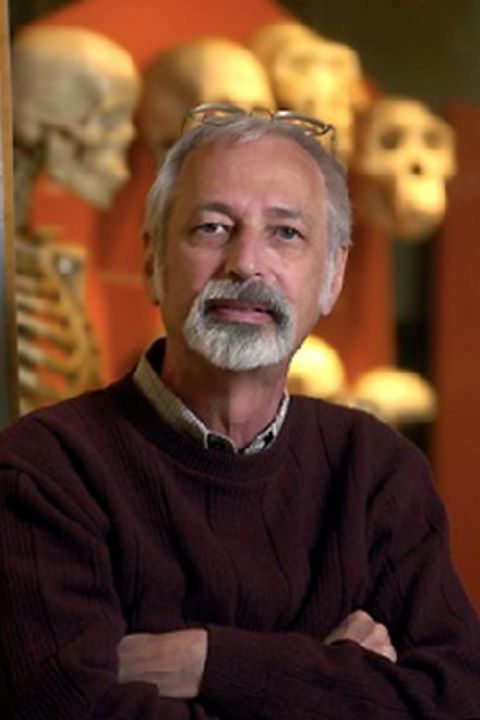
Owen Lovejoy’s eclectic research interests are likely explained by his educational history. Lovejoy’s first degree was in psychology, he studied for his master’s degree at the Case Institute of Technology, his PhD at the University of Massachusetts was in biological anthropology, and his post-doc at Case Western Reserve University was in orthopædic biomechanics. Since 1968 Lovejoy has been a faculty member at Kent State University—where he is now a Distinguished University Professor.
Lovejoy’s publications and distinguished lectures run the gamut from clinical orthopedics to pedagogy, via functional morphology, the origins of bipedalism, the earliest hominins and archeology. The topic of his PhD was the biomechanical context of modern human skeletal variation as reflected in the shape of the tibial shaft, and most of his early papers were collaborations with colleagues skilled in bone biomechanics. To my mind the most notable from the perspective of paleoanthropology was his classic 1973 paper (with Heiple and Burstein) demonstrating that because of the smaller endocranial volumes of australopiths, and thus the reduced distance between their hip joints, this meant that compared to modern humans the load on the femoral head during the support phase was reduced. The upshot was that the relatively smaller femoral heads did not preclude australopiths from being effective bipeds.
Lovejoy applied his extensive knowledge and interest in the evolution of hominin locomotion to develop a hypothesis suggesting that because bipedalism freed the hands from a primary role in body support and propulsion, it enabled bipedal early hominin mothers to carry their infants, as well as allowing males to share food carried to a home base.
Lovejoy was also heavily involved in interpreting many aspects of the functional morphology of Ardipithecus ramidus. His input was one of the main reasons why a series of papers in 2009 made the case that Ar. ramidus was one of the earliest, if not the earliest, hominin, and that the earliest hominins did not have a Pan-like ancestry.
Owen Lovejoy has had a profound impact on our understanding of the evolutionary history of early hominin posture and locomotion.
C. Owen Lovejoy Oral History Videos



Oral History Transcript
The transcript below is free to read and download.