

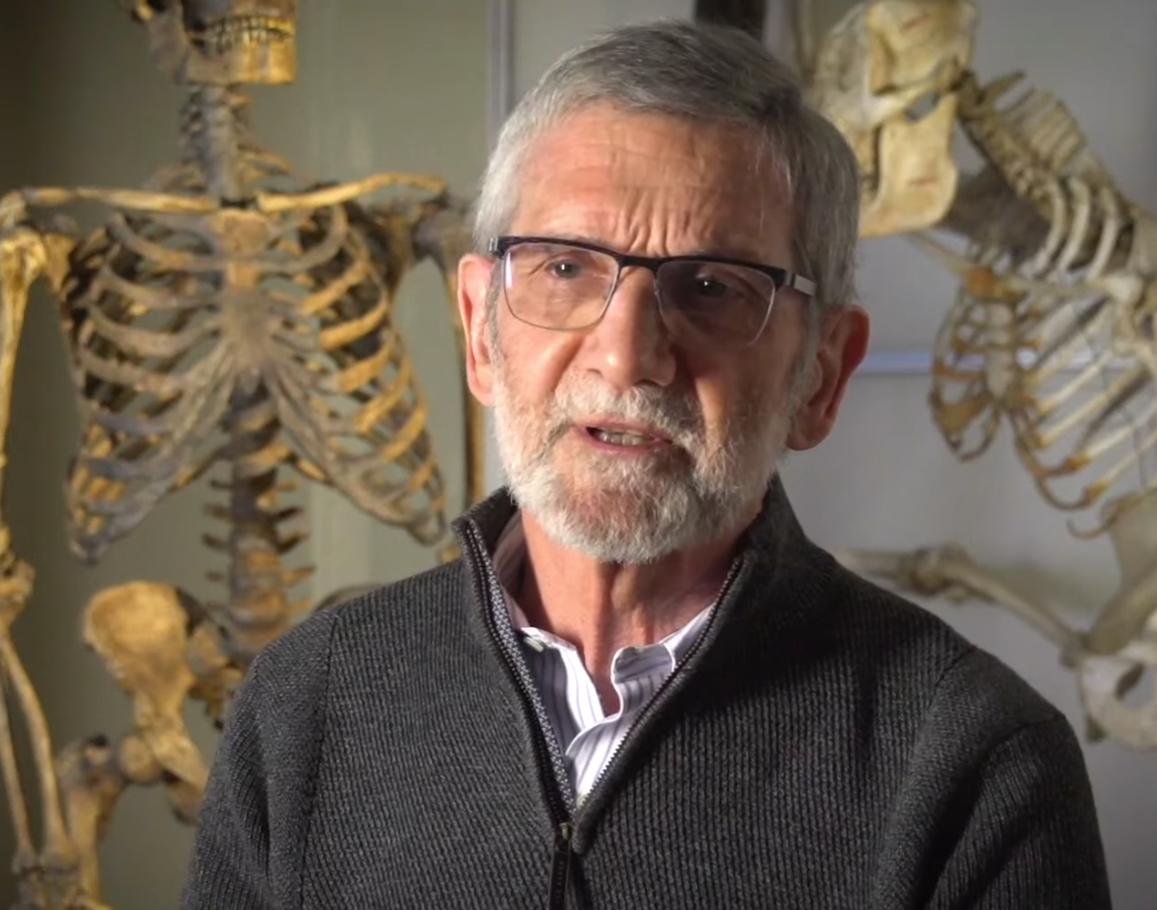
David Pilbeam (1940-)
Brief biography
Oral history interview recorded May 30, 2023
Interviewer: Bernard Wood
David Pilbeam spent most of his career at Harvard University, where he was Henry Ford II Professor of Human Evolution until his retirement in 2019. He was elected a Fellow of the American Academy of Arts and Sciences in 1985, and a Foreign Associate of the National Academy of Sciences in 1992 (and a Member in 1997).
Pilbeam has undertaken long-term field work in Pakistan, resulting in crucial evidence about hominoid evolution in Asia. His 1967 PhD thesis reassessing ape evolution within East Africa was ground-breaking, but he is perhaps best known for being the first influential paleoanthropologist to appreciate the significance of the impact of molecular biology on human evolution.
Pilbeam understood the implications of two independent—but related—developments in molecular biology. Evidence from DNA meant it was possible to generate robust hypotheses about how modern humans and the extant apes are related, and the principle of the molecular clock enabled researchers to place constraints on the timing of the splits among the various extant apes and modern humans.
When these constraints were applied to the split between orangutans and the African apes, and the various splits within the modern human and African ape branches of the Tree of Life, it became apparent that the Miocene ape Ramapithecus was too old to be an ancestor of later hominins; resemblances between Ramapithecus and hominins must have been independently acquired.
Pilbeam was quick to appreciate the implications of these advances, even though they required him to abandon the hypothesis that Ramapithecus was a human ancestor. His support of the application of molecular evidence was instrumental in modernizing paleoanthropology.
David Pilbeam Oral History Video

Oral History Transcript
The transcript below is free to read and download.
Selected Research Publications
2010 (with J DeSilva, M.E. Morgan, J.C. Barry) A hominoid distal tibia from the Miocene of Pakistan, J. Human Evol., 58: 147-154.
2013 (J. C. Barry, C. Badgley, A.K. Behrensmeyer, L.J. Flynn, H. Peltonen, I.U. Cheema, D. Pilbeam, S. Mahmood Raza, A.R. Rajpar, M.E Morgan. ) The Neogene Siwaliks of the Potwar Plateau and other regions of Pakistan. In Fossil Mammals of Asia. Xiaoming Wang, L. J. Flynn, M. Fortelius (eds). Columbia University Press.
2013 (L. J. Flynn, E.H. Lindsay, D. Pilbeam, S. Mahmood Raza, M.E Morgan, J.C. Barry, C. Badgley, A.K. Behrensmeyer, I.U. Cheema, A.R. Rajpar, N.D. Opdyke.) The Siwaliks and Neogene evolutionary biology in South Asia. In Fossil Mammals of Asia. X. Wang, L. J. Flynn, M. Fortelius (eds). Columbia University Press.
2014 (L. J. Flynn, M.E. Morgan, D. Pilbeam, J. C. Barry.) “Endemism” relative to space, time, and taxonomic level. Ann. Zool. Fenn., 51: 245-258.
2015 (M. E. Morgan, K. L. Lewton, J. Kelley, E. Otárola-Castillo, J. C. Barry, L. J. Flynn, D. Pilbeam) A partial hominoid innominate from the Miocene of Pakistan: description and preliminary analysis. Proc. Natl. Acad. Sci. USA, 112 (1) 82-87.
2016 (C. Badgley, M.S. Domingo, J. Barry, M. Morgan, L. Flynn, D. Pilbeam) Continental gateways and the dynamics of mammalian faunas. C. R. Palevol, 15: 763-779.
2016 (L. Flynn, D. Pilbeam, J. Barry, M. Morgan, S.M. Raza) Siwalik synopsis: a long stratigraphic sequence for the Later Cenozoic of South Asia. C. R. Palevol, 15: 877-887.
2017 (Co-Editor with M.M. Muller and R.W Wrangham) Chimpanzees and Human Evolution. Harvard University Press
2017 (With D. L. Lieberman) Reconstructing the Last Common Ancestor of Chimpanzees and Humans. pp 22-140 In Chimpanzees and Human Evolution. Eds M. M. Muller, R.W Wrangham, D. R. Pilbeam.
2017 (With M.M. Muller) The Evolution of the Human Mating System, pp 383-425 In Chimpanzees and Human Evolution. Eds M.M. Muller, R.W. Wrangham, D. R. Pilbeam.
2025 (With C. Badgley and M. Morgan) At the foot of the Himalayas (Johns Hopkins Univ Press), 553 p.